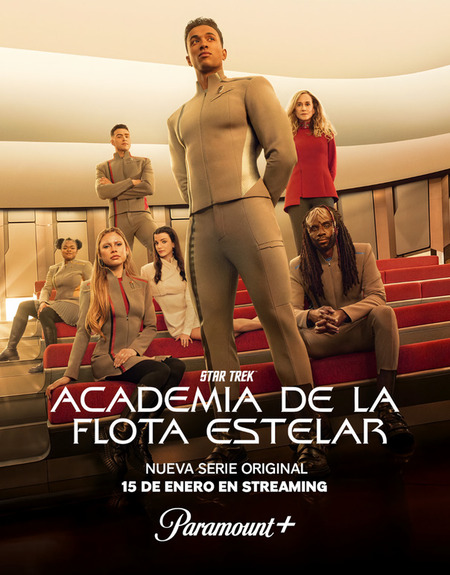
(courtesy IMP Awards)
As I wrote the review for the first three episodes of Star Trek: Starfleet Academy, I was impressed by how sophisticated a show it was so early in the piece.
There are a great many shows that wobble and stumble in their first season, showing promise and glimmers of excellence – think Star Trek: The Next Generation (TNG), Schitt’s Creek, Stargate SG1 as just three examples – but which ultimately do enough of the good stuff to make you turn up for season two.
But as Star Trek: Starfleet Academy has gone on its searingly intense and emotionally rich way, it’s become clear that here is a show about which a great deal of thought has been given and into which a great deal of love and care has been poured.
Interestingly, one of the criticisms of the show has been that it is too “Young Adult (YA)” but this belies the critics’ lack of appreciation of just go deep and honest and intense YA stories often are; they are not as light and fripperous as those who bemoan the genre seem to think, and while yes, there is a lightness to the stories which points to people just starting out in life, there’s also a gathering and seismic appreciation that all that innocence is about to go the way of the dinosaurs fairly soon.
Star Trek: Starfleet Academy absolutely nails what excellent YA storytelling looks like but it also encapsulates what has always made Star Trek shows such a rich and rewarding excursion into the complexities and the highs and lows of what it means to be human.
And in that respect, the show has quite a bit in common with TNG and Deep Space Nine, with its willingness to put its characters in harm’s way, to put their feet to the fire in such a way that any lingering sense that being a member of Starfleet is a thing of bright-eyed ambition are well and truly laid to rest.
The sense of innocence lost is strong, almost overpoweringly so, in episodes like “Come, Let’s Away” (episode 6), in which a routine training exercise in the wreck of the derelict USS Miyazaki becomes something altogether more traumatising and scarring at the hands of fascist gangster Nus Braka (Paul Giamatti), and “Rubincon” (episode 10) where Braka seeks to bring down the Federation whom he blames for the death of his family and some fairly dark and emotion-laden truths are handed out courtesy of two key characters – Starfleet Academy chancellor Nahla Ake (Holly Hunter) and Anisha Mir (Tatiana Maslany), whose son Caleb (Sandro Rosta) is a cadet, first reluctantly then wholeheartedly.
It is the showdown between these strong women that forms the heart of this episode certainly but which has influenced the look and feel of Star Trek: Starfleet Academy throughout its initial ten-episode run.
In many ways “Rubincon”, and no, it’s not a typo and relates to a glitch by the holographic Doctor (Robert Picardo) which actually proves pivotal ———- SPOILER ALERT !!!!! ———– to the Federation besting Braka in the final episode of the season, is a classic Federation-on-trial episode but one given a huge amount of emotional impact by the fire, fury and sadness of these two amazing women.
The story of Caleb Mir is what gives Star Trek: Starfleet Academy so much arc-heavy emotional heft, adding to the episodic nature of its storytelling which explores things like friendship and the barriers we place between ourselves and others (“Ko’Zeine”, episode 7), childhood, parenthood and resilience (“The Life of the Stars”, episode 8) and the thrill of the future even as the pain of the past, recent and otherwise persists (“300th Night”, episode 9).
The final episode takes the story of Caleb and Anisha, separated for 16 years, and Nahla, and folds into quite movingly into the story of a Federation trying to become again what it once was and instilling in their cadets a real sense of how important it is that they get it right.
But what Star Trek: Starfleet Academy does brilliantly well in these episodes, and throughout the entire series in fact, is uphold the nobleness and honour and truth of what being a Starfleet officer and a member of the Federation means – it is, in so many ways, a worthy carrier of Roddenberry’s original vision – while letting its main characters stumble their way and be pushed (depending on the situation), albeit with great emerging talent and competency, into that greatness.
This becomes hugely, affectingly clear in episodes six and ten, when the core cadet characters – Caleb, Klingon Jay-Den Kraag (Karim Diané), holographic lifeform Sam aka Series Acclimation Mil (Kerrice Brooks), captain aspirant Genesis Lythe (Bella Shepard), troubled heir apparent Darem Reymi (George Hawkins) and daughter of the President of Betazed, Tarima Sala (Zoë Steiner) – are forced to deal with a situation far beyond first year training.
They are forced to grow up fast in a couple of episodes where the truth of what it means to be a Starfleet officer is brutally forced upon them, and Star Trek: Starfleet Academy does an extraordinary job of portraying, thanks to stellar writing and exemplary performances, this hurried transition while also letting them be flawed humans too, capable of both greatness and fallibility in equal measure.
Growing up is far from easy and Star Trek: Starfleet Academy knows this intimately and lets the truth of that permeate into every narrative pore, just as any excellent YA-centred piece of storytelling, and this show is most certainly that, does without blinking.
Full of fun – it’s so great to see Discovery alum, Jett Reno (Tig Notaro) and Sylvia Tilly (Mary Wiseman) doing their thing, in equal parts funny and moving – and some truly dark and searing moments, Star Trek: Starfleet Academy is both vintage Star Trek and its own marvellously light and dark beast, an excellent addition to franchise canon which shows us how greatness is made and that at the heart of every hero is a human being who had to grow up fast and somehow survive the transition intact.
Star Trek: Starfleet Academy streams on Paramount+