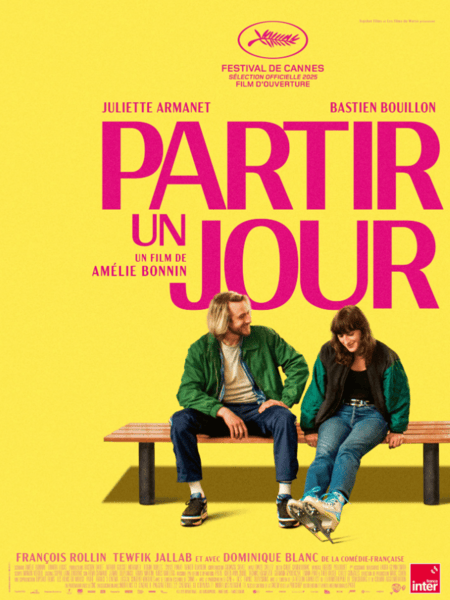
(courtesy IMDb)
Mixing the past and the present can always be a little awkward and more than a bit emotionally unsettling.
But much of the time that’s not an issue for anyone, with the past and the present separated by a sizeable gap of years; that is, of course, until you go back to your hometown and then suddenly the two periods of time, the two states of your being, are suddenly sharing the same space and it’s not always the easiest thing to navigate.
Case in point is celebrity chef on the rise, Cécile Béguin (Juliette Armanet), protagonist of Leave One Day (Partir un Jour), who is getting ready to open a gourmet restaurant in Paris, on the back of her win in the reality TV cooking series, Top Chef, in which she made some disparaging remarks about regional French cooking and how provincial it all is.
That might normally not be an issue except for the fact that her father, Gérard Béguin (François Rollin), who owns and runs a truck stop cafe where Cécile grew up, has just had a great attack, compelling his daughter to race to his side (rather hilariously by taking rides with truck drivers but then she knows many of them from her childhood so maybe not so strange, after all).
Gérard, who it turns out has recovered reasonably and cannot understand why his daughter bothered to come home at all – theirs is a fractious relationship, governed by a complete lack of understanding about what drives the other person to do what they do – and rather unfortunately for Cécile has written down every negative thing she ever said about the food of her childhood.
Still, whatever Gérard may think of his daughter and her highfalutin culinary ways, he needs her to stick around her and cook while he gets back to full strength, meaning that who Cécile was and who she is are forced to share some quite uncomfortable time together before she can return to Paris.
As Leave One Day (Partir un Jour) progresses, we learn that Cécile is not the only one who dreamed of getting away with her exasperated mother – she loves Gérard but is also maddened by him in equal measure – Fanfan Béguin (Dominique Blanc) still longing to go to Spain on holiday in the campervan she sits in in the backyard, her only respite from the demands of a very hometown bound life.
Cécile’s unexpected enforced stay in her hometown not only brings her into close quarters with her parents, for bad and then some healing good, but with her high school crush, Raphaël Tenreiro (Bastien Bouillon) who is not exactly happily married but hanging in here anyway.
In just a short few days, Leave One Day (Partir un Jour) takes Cécile, her parents, Raphaël and even her partner in love and business, Sofiane Garbi (Tewfik Jallab) on an unsettling trip down memory lane all while they remain firmly rooted in a present which doesn’t quite know what accommodation it should make with itself.
Full of searingly incisive moments that mostly bring about healing and understanding – there’s one scene in the early hours of the morning where Cécile and her father bond over cooking the dish she is trying to perfect for her restaurant’s opening in just a couple of weeks, and its nuanced and lovely and very real all in one – Leave One Day (Partir un Jour) does much of it emotional exploration in song.
An unexpected musical, trailer-wise at least which doesn’t scream music and song from every panel, the Amélie Bonnin directed and co-written (with Dimitri Lucas) film doesn’t always deliver the goods musically, nor absolutely excel in their placement, with the songs feeling more than a little tacked on unnecessarily in some scenes which could have benefited from remaining tuneless.
However, once you settle into the fact that the actors will burst into song when you least expect it, thanks mainly to the film feeling like more of an slow-boiling slice-of-life drama than a musical, Leave One Day (Partir un Jour) has a charm all its own, a warm and inclusive exploration of how coming face-to-face with the past may be just what your present experience of life needs.
That’s not to say there won’t be trauma, and clearly Cécile and her father have a lot of resentment and past pain to sort through, just as Raphaël and Cécile have to navigate through long suppressed and gestating feelings for each other, but by facing up to a past she fled rather then sort through, Cécile finally finds some measure of peace with her family, her hometown, high school crushes and her suppressed past.
Being a French film, and not feeling the very American need to tidy everything up completely neatly and prettily by film’s end, Leave One Day (Partir un Jour) doesn’t suggest that all that hometown therapy of life actually fixes everything.
But as Cécile jumps into a Paris-bound truck with question marks over a few things such as her relationship with Sofiane (though you suspect they will be fine, their strong relationship able to survive one highly fraught argument), you get the impression that she will be okay in the end.
The refreshing thing about Leave One Day (Partir un Jour) is that it doesn’t feel the need to answer every question and dot every emotional “i” and cross every broken “t”; rather, it suggests that healing has taken place, than things are better than they were, and that is enough for you to believe that Cécile is now better equipped to handle what lies before than she was before.
She isn’t completely fixed and not everything is sorted but as Leave One Day (Partir un Jour) delivers its last heartfelt song and has its characters examine long ignored hurts and breaks, you are left feeling that, like many musicals, some very real things have happened in the occasionally, hyper-real musical moments and that singing your heart out and letting the pain and your truth find expression might just be the best therapy going around.