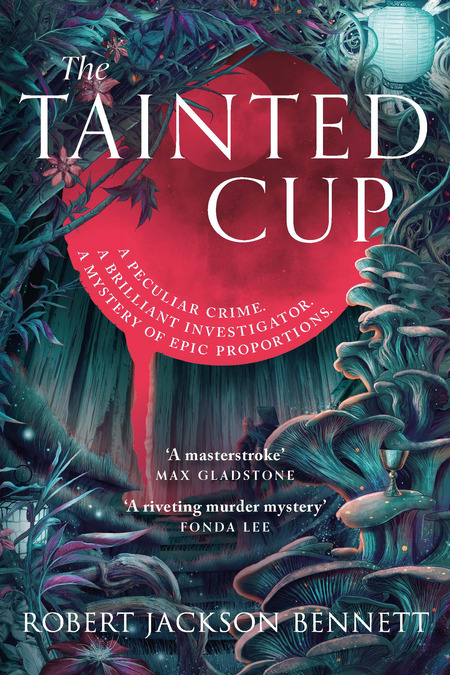
(courtesy Hachette Australia)
As deaths in murder mysteries go, the one that that graphically kicks off all the fantastical sleuthing in The Tainted Cup by Robert Jackson Bennett is hard to beat.
That doesn’t escape the two people assigned by nervous local authorities – idiosyncratic, fiercely intelligent and socially awkward investigator Ana Dolabra and new fresh-off-the-augmentation line “engraver” Dinios Kol who has been magically altered to possess the mother of all eidetic memories.
While Dolabra happily stays locked away in her home, only emerging with a blindfold into public to curb the assault on her senses that everyday life presents, Kol is the one who, nervously at first since this is his first murder and his first encounter with the power hierarchy that permeates an Empire that might be past its prime, investigates what emerges as a sprawling conspiracy that seems to leave no one untouched by the end.
The murder at the heart of the book is what stops Kol in his tracks (though Dolabra, a voracious reader and acquirer of knowledge seems more delighted than horrified) – an Imperial officer is found in his guest quarters in a mansion in a remote canton of the Empire skewered at the end of a virulently growing plant which has exploded from him and ended his life in spectacularly grisly fashion.
Everyone who sees it is terrified by the sheer impossibility of the murder and no one, save for Dolabra, can begin to explain how a death like this could even happen.
‘Tell me everything,’ she [Dolabra] said. ‘Everything you’ve engraved within that pretty little skull of yours, Dinios Kol. Go.’
I opened my engraver’s satchel, slid out the vial of lye aroma, uncorked it, and inhaled deeply. Then I felt a flutter behind my eyes, and I started talking.
This most fiendish of murders kicks off the murder mystery in The Tainted Cup which weaves a brilliantly complex but wholly accessible story which takes a deep dive into a world which exists on a precipice much of the time, its continued existence hostage to monstrous leviathans which come ashore during the wet season and which are only held back by towering walls and “bombards”, weapons which seek to kill them before they can emerge from the sea and wreak terrible havoc on land.
No one wants to live right on the coast, and indeed the rich and the powerful mostly live in the inner rings, protected by vast walls and weaponry dedicated solely to keep the dangerous world away from their pampered, corrupt and indulgent lifestyles, but a good many have no choice, including legions of augmented engineers, magically altered, like so many in a land where all kinds of magical potions and procedures make people far more than they would otherwise be (though not without great eventual cost).
The engineers are charged with keeping the Empire safe, its continued legitimacy and authority resting on its ability, not only to keep its citizens safe but to keep normal life continuing on without interruption.
So when the brutally imaginative murder that Dolabra and Kol are called on to investigate begins to grow in size and impact, threatening the very heart of the Empire itself, The Tainted Cup becomes the story of a somewhat faded world hanging perilously in the balance.
(courtesy official author site)
While Kol spends much of his time holding on for dear life on the biggest of all learning curves, his successful mastery of which will materially affect the fate of him and his family, Dolabra is having the time of her life, loving the challenge of putting a thousand fractured puzzle pieces together in an Empire where certain vested interests don’t necessarily want things solved.
The Tainted Cup thrives, not only because of the many imaginatively realised parts at the heart of its beguilingly complex story, but because Dolabra, long in the job and astonishingly good at it, and Kol, who proves to be able to master a great many skills though not reading or writing to his great frustration, are such enthrallingly good characters to spend time with.
And you do spend a great deal of time with them, with the mystery at the heart of the novel demanding all their time, energy and attention.
There is a LOT going on, none of which can be mentioned because spoilers are the death of the enjoyment of any brilliantly good murder mystery, and this is right up there with the best, but at no point does The Tainted Cup ever feel overstuffed or out of reach, its story put together so perfectly that you marvel at the author’s ability to keep all sleuthing ducks in such an immaculate row.
The pieces, which seem scattered and messy and leading to nothing, come together with an elegance that delights and surprises, unless you are one of those readers who can, like Dolabra, see a pattern well before anyone else.
Her cold amethyst gaze searched my face. ‘Yes,’ she said. ‘Follow, and we shall take you.’
I did so, treading along after the axiom and the engraver—but Fayazi walked behind me, and whenever I glanced over my shoulder, she was watching me very closely.
Replete with thrillingly immersive world-building and a gift for connecting dots that gives you enough information to be satisfying while leaving enough intrigue to propel the story page-turningly onwards, The Tainted Cup reminds this reviewer of genre-busting and rebuilding novels like The Seven Deaths of Evelyn Hardcastle by Stuart Turton which are Agatha Christie-level classical in their sensibility and approach but which absolutely reinvent the genre with jaw-dropping complexity and inventiveness.
That the author pulls off such a thoroughly satisfying without breaking a novelistic sweat is a thing of beauty and awe, but that he does it while keeping some raw humanity at the heart of the tale is even more impressive.
It would be easy to have a mystery this complex and clever swallow itself up in its ingenuity, and there are surely more than a few times where this could have happened if the story were in lesser hands, but Bennett always keep his eye on the prise, remembering that though this is a fantastical tale of an Empire build by magic and imaginative use of technology which has its source in mastery of the natural world (though not without contagions wreaking hell), there are people at its heart, both investigators and victims.
The Tainted Cup is a stunningly good read, a novel which has so many parts furiously spinning in a cog-intersecting frenzy but which never falters, rewarding readers with a mystery worthy of being solved, characters who demand to have attention paid to them and an appreciation of humanity that understands that even when magic rules the world people will still be people, and often murderously so.