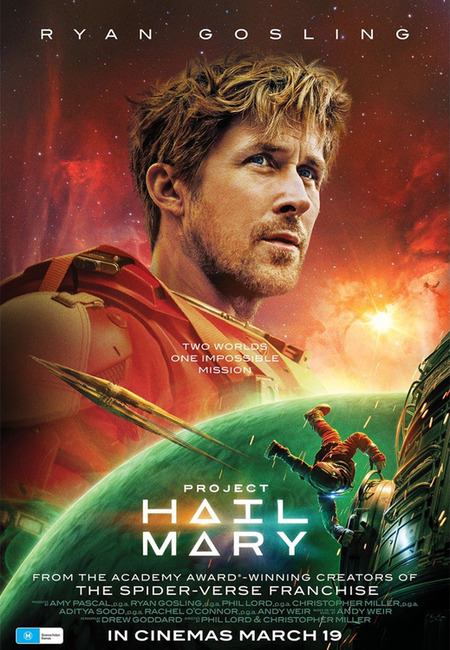
(courtesy IMP Awards)
At the heart of every great and enduring sci-fi story, sits an impressive amount of evocative humanity.
It’s easy just to see the spaceships and the planetary expanses and aliens and wars and epic space opera sprawling across millennia and impossibly far light years of stars and nebulas and galaxies, but dig down into the really good stories, and there are a lot of them and you will see into the very heart of what it means to be human.
Sometimes literally (but then this is not that kind of grotesque tale) …
Released in 2021, Project Hail Mary, though possessed of a fantastical premise, an out-there execution and an almost fairytale-ish resolution – none of that is a criticism; rather, an acknowledgement of the story’s epic, blockbustery scope – is a novel that sings with the very things that make being human so scary and inspiring and alive and fragile and hopeful.
It’s that resonant humanity that makes this such a compelling story to read, and now watch, thanks to superbly good directing by Phil Lord and Christopher Miller and a superbly paced screenplay by Drew Goddard, with every beat of the narrative offering something that makes you gasp and sigh in recognition, and also laugh a lot.
Because while the protagonist, Ryland Grace (Ryan Gosling in brilliant form, just the right mix of vulnerable and can-do) is up against it, as is the entire human race as the sun starts dying (along with all the other suns but one in the Milky Way) for reasons no one can explain, he is also very human and as humans, we tend to approach things that are dark and forbidding with a reasonably amount of humour too.
In Ryland’s case, much of the humour stems from the fact that he wakes up years into an interstellar voyage to the one sun that is defying the odds with no idea who he is; all that cryogenic sleep that’s meant to keep him fresh as a crisis-solving daisy until it’s time to swing into action has more of a deleterious effect on him that scientists back home imagined.
He wakes up deep in the middle of the galaxy alone, uncertain about who he is and completely thrown by the fact that when he looks out the window all he sees is stars.
That’s likely got a lot to do with how he gets there – the scene that sees him join the expedition is equally parts scary and funny and perfectly, relatably human – and shorn of short-term knowledge about who he is and what he can do (former molecular biologist and school teacher), all his scientific skills ands accomplishments temporarily lost to cryogenic anomalies and not a little psychological distress, Ryland has to slowly piece back together why he’s out in the middle of galactic nowhere to begin with.
Which is, of course, and at this point we know more than Ryland does thanks to an adept mix of present confusion and expertly deployed flashbacks, to save Earth from a slow descent into a Sun-less freeze.
Project Hail Mary is the last throw of the dice for humanity, and also it turns out a race known as the Eridani, faceless, rock-like beings from the planet Erid who are far more advanced and who arrive at Tau Ceti, where the unkillable sun is pulsing away as if nothing is untoward, for the same reason people do – to save their world from oblivion.
With his memories and skills slowly coming back, Ryland initially flees contact with the alien he comes to call “Rocky” (James Ortiz primarily voicing the puppet) but time and circumstance intervene, and soon Ryland and Rocky meet and become colleagues, fellow scientists and, most importantly for this gloriously evocative story, deep and abiding friends.
The brilliance of Project Hail Mary, both as a book and a movie, is that it understands that nothing humanity does, or in this case, aliens too, is ever shorn of who we are are in all the universality of our feelings, thoughts and strengths and weaknesses.
There is a tendency in epic hero stories to make the story itself bigger than Ben-Hur and the hero a faultless conqueror of darkness and terror and threat but the really moving stories, especially in our modern age, are those that imbue the hero with some highly relatable fragility and vulnerability.
We never stop being human, no matter what we’re up to, and even when we’re trying to save the world with our new alien friend, who may not have a face as we know it but who is so alive and sweet and funny and thoughtful that you can’t help, like Ryland, seeing him as a being every bit as human as we are, we laugh and cry and doubt and hope and surge and fall back.
In other words, we keep being human throughout, and it’s the story’s ability to keep being an heroic tale while still being a sage lesson in what it means to be human, that makes Project Hail Mary such a brilliantly moving and funny movie to watch.
The film manages to balance terror and sadness, goofiness and vibrant friendship perfectly, and it’s full of scenes where you dance between all kinds of extremes, sometimes in the space of a few minutes.
The ending may be expected, although how they realise it is not and a thing of remarkably affecting beauty and a testament to how connection and community can change everything if you are open to it, but every step of the way Project Hail Mary surprises you with its ability to get the very soul of what it means to be alive.
It’s great gift is that, even though it’s a big, bold behemoth of an epic tale, it never forgets the humanity at its heart, and whether that’s expressed as determination, intelligence, comedy or aching vulnerability or frightening mortality, it’s the emotional intimacy and rawness at its beating heart that sustains it and carries it through and which makes it one of the absolute standout films of year, even this early in the calendar.
Look! An interview …
Or two …