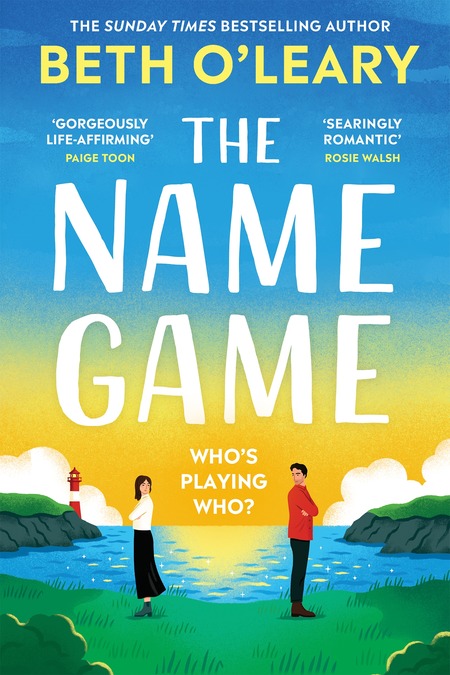
(courtesy Hachette Australia)
It’s a truism of any form of storytelling that genres generally come with cast-iron rules.
If you want to write in those genres, and have people, in this case, read your books, you have to include certain tropes and cliches to keep the punters happy; however, simply ticking the boxes can end up being supremely unsatisfying, not simply for the readers but for the author too.
So, it’s a delight when an author takes the core genre elements and has some fun with them, giving a shot of vibrant originality to the much-loved, same-old, same-old, and making the escapist adrenaline you crave feel like the first time feel all fizzy and new again.
Beth O’Leary is one genre-specific author who is absolutely not satisfied with simply retreading the genre footsteps of old, and her latest novel, The Name Game, empathatically underlines how genre-subversive talented she is and why one of the romcom genre greats, Emily Henry (also happy to upset the genre applecart) was led to declare that “Beth O’Leary is that rare, one-in-a-million talent”.
What is so compelling about The Name Game is that, in many respects, it starts off as a cut-above-the-average but reasonably straightforward romcom where two people, both named Charlie Jones, end up on the fictional island of Ormer (modelled on the actual island of Sark) in the Channel Islands, to take up a position as the manager of the local farm shop.
She swiped a hand through the kisses she’d been drawing in the sand. ‘I lost someone. But I think I lost myself long before that, really. I’ve spent a great deal of my life waiting for people to give me the life I want, but I realise now that I need to be the one to take it, actually. By myself, for myself.’
The only problem (well, among many to be fair)?
There’s only one position and the farm owners, married couple Rosie and Marly, surprised to have two people turn up for a job they are fairly certain they only offered to an individual, agree that both the Charlies can work together for half the pay which the two would-be managers agree to simply to stay in a place that offers them vital second chance both need.
Both of them are nursing pain, loss and the sad lingering stain of past mistakes, and neither of them really want to give up this opportunity to reinvent themselves and their lives.
But clearly something has to give, and after some initial argy-bargy and complications, such as having to share the same small one-bedroom accommodation – hello steadily building situational URST – and being suspicious of the other’s person’s motives and actions, the two Charlies fall into a cooperative pattern of working together and slowly but surely sharing snippets of their true selves.
So far, so romcom standard – although in O’Leary’s delightfully skilled hands, “standard” is way above the usual run-of-the-mill romcom fare – but then with the narrative building towards what looks like a standard resolution, all the usual ending options are thrown into the storytelling blender and an altogether out-of-the-box novel emerges.
No details because the spoilers are considerable and the shock of where it all twists and turns shouldn’t be ruined for anyone, but suffice to say that The Name Game ends up being one of the most creative romcom novels to come this reviewer’s way in quite some time.

It’s hardly a surprise because O’Leary’s second-to-last novel, Swept Away, also took a fantastically original premise and ran with it with gusto and some genuinely intense heartfelt emotion, with both novels underscoring that here’s an author game to reinvent things and more than capable of delivering on that ambition.
If you’re looking for the buzz of romantic contentment that comes with reading romcoms, you will absolutely find what you’re looking for but if you also want to feel like it’s all fresh and new too and that’s here’s someone more than skilled at delivering that, then you need to dive into The Name Game as fast as your TBR pile will allow you.
If you do, and really why are you still standing here thinking about it, you will meet two people who are beautifully built to fully-realised form from the ground up, who go from enemies-to-friends to so much more, and who capture your hearts because you want them to find the happiness they idealistically dreamt would be theirs the moment they set foot on Ormer.
O’Leary does an exemplary job of alternating between the past and the present, and there’s no point where you want to race through the vividly told stories of their painful pasts simply to get back to the present, or vice versa; every element of the story matters and feed beautifully into the others, all of them adding up to a satisfying whole.
Charlie always knew what Jones was feeling, and what he needed, and it seemed that still held after almost a year and a half apart. He felt dizzy with the urgent desire to see her, aware all of a sudden of the aching hollow inside himself that had remained empty ever since he’d walked away from her.
The beauty of The Name Game is that for all its brilliantly involving genre envelope-pushing, its so impossibly and wonderful romantic.
Regardless of why you pick up a romcom, at the end of the day you want to feel like love is a real and palpable thing, something that is as good and wondrously uplifting as you’ve always hoped it would be and that you’ll walk away from reading the novel feeling immensely better around the world.
The joy of The Name Game is that delivers all the richly romantic feels and more, so mission absolutely accomplished when it comes to making you feel sigh-worthy romantic inside, but does it with a keen eye on how difficult life can be and how much all the things we long for can feel impossibly out of reach.
Both of the Charlies are walking away from all kinds of past pain, and treat their second chance at a happy life on Ormer as a desperately hopeful last roll of the dice, and it’s the patience of O’Leary in letting their stories be told which add so much richness and emotional heft to romcom machinations of the present.
And The Name Game‘s present story of pasts escaped and presents built, even with a myriad of gloriously convoluted (in the best possible way) is a compelling mix of raw humanity and romantic hopefulness that will capture your heart and maybe even leave you feeling like this kind of love is possible in the real world because the characters, in an exaggerated situation, feel so real and people you can relate to and will remember long after you have turned the last page.