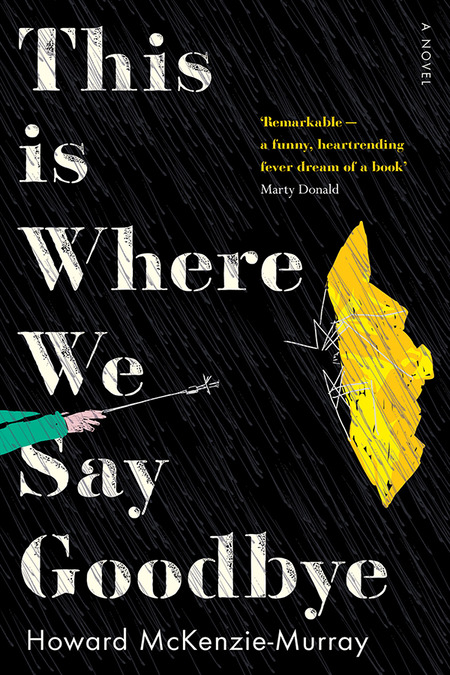
(courtesy Fremantle Press)
We live in a society mortally afraid of death and so, when it someone we love dies, it’s expected that our expressions of grief will not be prolonged and will stay on socially neat lanes.
Its a ridiculous expectation to have for a whole host of emotional and mental health reasons, but also because grief doesn’t meekly stay it’s directed to go and can surprise with when and how it occurs and how chaotically it impresses itself on our disrupted lives.
When this reviewer lost his father and mother to serious illness within three years of each other, I discovered that far from being something you could easily corral so people don’t become too uncomfortable, grief wasn’t not content to behave itself and while I didn’t do quite what the protagonist in This is Where We Say Goodbye by Howard McKenzie-Murray does in the event-filled day in which her dead brother’s wake and funeral (in that order because #reasons), I was all over the place.
I lay on the couch for weeks watching Scooby Doo cartoons, I withdrew from the usual pell-mell social hubbub of life, and I found it hard to keep my grief neatly contained; so, reading This is Where We Say Goodbye was a revelation, a joy and a relief because it embraces the idea that we can’t order our distress at someone we loved deeply dying to play nice in the often messy sandpit of life.
Don’t you think there should be at least one day a year when it’s illegal to put on your brave face? And when someone asks how you are, it’s against the law to go ‘fine, how are you?’
Maud Tarkington is already at a crossroads, unsure of whether she wants to keep studying to become a doctor, when her family receives news that their beloved son and brother Lloyd has died while overseas in Paris.
Once a high-flying star lawyer at a prestigious corporate firm, Lloyd suddenly quit out of nowhere, though if you were paying attention it was clear he was depressed and not happy with the state or trajectory of his life, and decamped to France, something that rattled Maud to the point where her last interaction with her brother was a big screaming row.
She regretted it almost instantly, as many of us tend to do in the messy aftermath of such confrontations, but Lloyd withdrew fairly obviously from her, unable or unwilling to bridge the chasm that opened between the once-close siblings, and now, of course, that breach can never be surmounted.
So, on the day of the wake and funeral, Maud is already emotionally on edge, a state of highly-strung vulnerability which sees her, in the midst of trying to write one last letter to Lloyd (she’d been told that was a healthy way to deal with unexpressed pain and regret), racing around Perth in a desperate attempt to prove to herself that maybe the whole Lloyd dying thing is just one big, poor-taste gag.
It’s not and you suspect Maud knows that in her heart of hearts, but grief rarely sits down and calmly and rationally looks at rational truths, a thing of gritty, messy emotionalism that simple has to act, even if it’s not within the expected boundaries society sets for it.

(courtesy Fremantle Press)
The wholly marvellous thing about This is Where We Say Goodbye is that while it’s as quirky as hell, resembling some sort of weird fever dream adventure where Maud encounters one of Lloyd’s closest friends, who sees accidental kidnapping of his bestie’s sister as a way of poorly handling his grief, and in which she is running from her sister and brother in a graveyard because she can’t face the fact that the wake and funeral mean there’s no going back from the fact that Lloyd is dead, there so much emotional truth to it.
The novel charmingly and with great vigour takes you on an Alice’s Adventures in Wonderland journey of grief, loss and white feathers fluttering down everywhere (that only Maud appears to see) but never forgets that here is someone with an aching, craterous hole in their heart that will never really properly be filled again (a hole begun years earlier, showing that grief often builds on past trauma and loss).
That is the truth and horror of grief, that you will never the same person again, and that life as you knew has died with the person you lost, and This is Where We Say Goodbye embraces that in a way that adds some potent emotional heft to some bizarrely amusing scenes.
The novel acknowledges too that there is a special kind of grief that exists between siblings and within families and that while the outside world handles pain and loss of this person in one way, it’s a particularly personal and devastatingly thing for the family.
When someone dies, everything of theirs should disappear with them. Their smell should leave and their miniature basketball ring on the back of the door. And they won’t be needing their shoes, so they should go too.
What really works for This is Where We Say Goodbye is that the author seamlessly balances the absurdity of much of Maud’s unusual excursion into messily diversionary grief, which includes trying to track down her closest childhood friend and clear love of her life who opted to join a monastery, sundering any plans she had for a future with him, with how raw grief can be.
Neither cancels nor reduces the other in intensity and so the quirky charm of Maud’s dash across a rain and storm-soaked Perth, which feels unsettling and uncomfortable at times, in wholly human and intensely understandable ways, sits impactfully cheek-by-jowl with her desperate, unanswerable grief.
If you have ever lost someone, Maud’s chaotic, unorthodox reaction to the finality of Lloyd’s death, and you don’t get much more final than a wake and a funeral, and again in that order, will really make sense to you.
Even if you don’t all the “right things” and turn up at the funeral and the wake as scheduled, there is a messy, rawly impelling part of you that just wants to run away screaming and curl up in an eternal foetal position and never, ever stop crying.
That’s the grim, unpleasant and all-too-real truth of it, and This is Where We Say Goodbye captures it perfectly in quirkily affecting detail, offering eventual hope too, but acknowledging that if you fall apart and can’t grief as you’re supposed to do (stupid rules, honestly), that that’s okay and you’ll find your way out of it all, in one way or another and life, while broken, might slowly begin to quietly heal itself again.