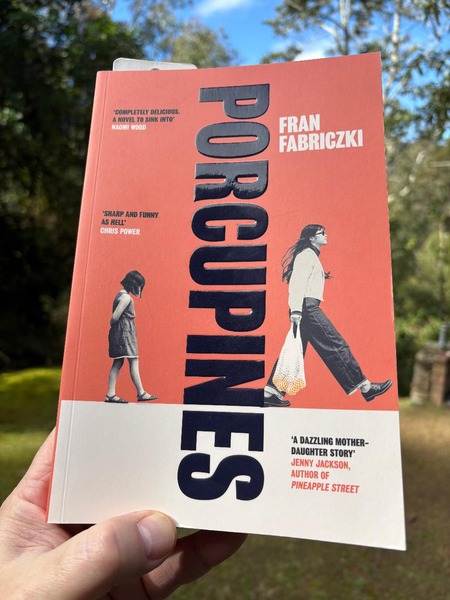
This novel was read at Kalimna, Yeranda Cottages, Main Creek (Dungog) NSW, August 2026
If there’s one thing that is guaranteed to get me diving into a novel faster than you can say “Yes, I’ll buy that book!” (a favourite and enduring phrase of mine) it’s saying that the novel in hand, and it’s almost always in hand, is similar to xx or yy program but with these extra things added.
You see, I don’t want the exact thing all over again because where would the fun be in that, but I do want something like it, something that feels like it but doesn’t ape it exactly.
Enter Porcupines by Fran Fabriczki which author Courtney Maum (I Am Having So Much Fun Without You) described as being like “If Gilmore Girls has sharper edges and came with a Los Angeles sunburn, you’d have this riveting novel’.
Gilmore Girls but with added extras? I am so there, with bells on and happy smile on my face.
But the bells and the smile are all anticipatory, and while I don’t doubt Mum’s sage judgement for a second, one person’s Gilmore Girls is another person’s American Horror Story. (OK, that’s not even remotely true but it sounds suitably dramatic, doesn’t it?)
Happily though in this case Maum was right on the money and Porcupines is exactly as described, a perfect blend of a close knit single mother-daughter relationship which has a lot of warmth and love at its heart but which knows the world around it is rarely as lovely as what happens within the four walls of a family home.
The book’s cover has a rough pencil sketch of Shostakovich’s profile, a benign rendering that has softened the oppressed intensity of his eyes from early portraits. Mila has been carrying it around with her everywhere, and the image has become stamped onto her imagination to the extent that any mention of an adult man now evokes this figure. It is just as well that there are no actual images of Shostakovich to compare it to—the man consistently sat for portraits with the bearing of someone in a hostage video. (Russian portraiture does leave something to be desired—one look at Rasputin will leave anyone questioning Boney M for life.)
Moving with narrative ease between Washington D.C. and Hungary in the early-mid-eighties, and L.A. in the nineties and very early 21st century, Porcupines is the story of Sonia/Szonja (it reverts to Sonia largely because of a bureaucratic spelling mistake) and her daughter Mila, a fifth grader who is as serious and studious as her mother is exuberant and spontaneously fun-loving.
Living in the sun-drenches suburbs of L.A., Sonia’s life is one filled with off-the-books sewing jobs and skirting the edges of illegal business, making sure no one gets too close because there are real dangers if they do, and living out the often confusing aspects of American life such as staging Mila’s birthday party in a way that matches expected societal norms.
It’s a lot to juggle, and lonely too since Sonia is estranged from her older sister Rina, a devout Orthodox Jew who has taken on the sort of religious trappings her family back in Hungary never embraced – its as the Cold and being an irreligious party member was all that mattered – and her parents back in Hungary.
It’s not a brutal, angry estrangement; rather, one born of pragmatic neglect since too much closeness, even with family, could imperil the ability of Sonia to stay in the States.
In many ways, Sonia and Mila are an entire world but it’s one that Mila, without knowing that’s what she’s doing, is straining to enlarge or even escape as she slowly begins to shed her outsider status and make friends at school.

(courtesy Curtis Brown)
Mila is also someone who loves facts and mastering things, and while it may seem quirky to outsiders, she combines, thanks to some practical thinking by her mother, she takes swimming lessons which are followed by violin lessons in the bleachers.
She also reads books about composers like Shostakovich and doesn’t care if the other kids think she’s weird; hers is a hermetically sealed that pays no heed to social convention and peer thinking.
Well, that’s what Sonia thinks until she finds a guide to being popular at school in Mila’s schoolbag and realises that maybe her outside daughter wants to be on the inside more than she lets on.
Mila is also desperate to know more about her mother’s past, and while Sonia and Mila have the sort of close relationship that you will remember from Lorelai and Rory’s relationship where everything is on the table and questions can be asked, the one thing Sonia’s is endlessly tight-lipped about is her past.
The tremors brewing in Sonia and Mila’s largely trouble-free world come to a head on a school orchestra trip to San Francisco where Sonia’s social isolation is tested, Mila slowly inches towards having friends, though not without messy missteps, and Sonia’s past come racing up to meet her at the hands of her daughter who means well but has no idea what it is she ’s playing with.
For all their shared DNA and all of their time spent soaking up each other’s habits, there is a fundamental difference between mother and daughter: Sonia is alive to the joys of life, perhaps naturally inclined to indulge in them too much, and is forever repressing her exuberance to suit her circumstances; Mila views what little of the world she’s seen with scepticism and her place in it with uncertainty, but for the sake of fitting in, she rouses herself into some form of sociability, however inept.
Told with incisively warm and familiar prose, and a real gift for funny, inventive prose which have you laughing at Fabriczki’s clever ways with words, Porcupines is a beautifully rich and heartwarming story about connection and family, friendship and belonging and the many forms home can take.
It also takes a long hard look at how even the closest of familial relationships, and for the occasional eye-rolling and frustration, Sonia and Mila are tight, can come under pressure when the truth isn’t allowed to see the light of day, even if it for very good reasons.
It also empathetically examines what it is like to have to re-invent ourselves and to tell ourselves that what what we have discarded had to be left behind and that we are better off without it.
But for all of Sonia’s sass and sense of fun and willingness to embrace the silly and plasticky things of life, she is labouring under a weight she tells herself she doesn’t have and much of Porcupines thoughtfully explores how hiding her Hungarian past and keeping family as a distance and not being part of the community is now doing perhaps more harm than good.
Certainly Mila is rapidly getting to an age where she can see deficiencies in the way Sonia and she interact with the world around them, and it is as these come to a head that Porcupines really picks up an affecting and yet funny head of steam as matters come, as they always do despite all the hiding we do, to a head.
Porcupines is a novel you happily lose yourself in to a wondrously immersive degree, its warmth, humour and fizzy relational energy sitting neatly alongside, darker, sharper concerns, withy all of them adding up to the story on a mother and daughter who want everything the world can offer them but aren’t sure, not yet at least, how to get them, or just as crucially, to hang onto them.