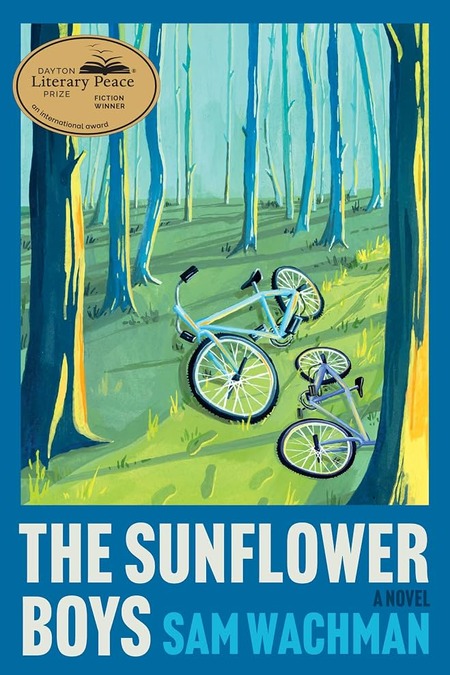
(courtesy Harper Collins Publishers)
We all know how powerful storytelling can be.
But it’s storytelling that shines an often uncomfortable spotlight on real world events that really has the capacity to hit home, and hit home hard.
Case in point is The Sunflower Boys by Sam Wachman which takes you into the heart of Russia’s completely unjustified invasion of Ukraine and brings it searingly and movingly alive in ways that no news broadcast has been able to.
And there have been a lot of news broadcasts on this wholly unjustified war.
The Sunflower Boys takes us into the heart of this horrific war in ways that tear your heart over and over again, but it does so in ways that feel wholly authentic and real because it takes its time to set the scene, using well over a third of the book to take us into the lives of 12-year-old Artem and his younger nine-year-old brother Yuri who live a reasonably happy life in the northern Russian city of Chernihiv.
While they feel the emotional and physical impact of their father’s absence – like many Ukrainian men he has had to go overseas, in his case the U.S. to find work that pays enough more than what he earns as a cardiologist back home – Artem, who’s a budding artist though he struggles elsewhere at school and Yuri, who has a boundless curiosity for life and learning, are safe and protected in a city where they know everyone, and where, during summer, they can escape some distance south to their grandfather’s sunflower farm in what is now a ghost town.
Someday I will miss this place. Someday I will miss the special way the light strikes the earth here. But I don’t know it yet. I don’t think that young birds anticipate how badly they will miss the sky when they grow too old and frail to fly. I think they just keep flying until one day they wake up in their nests and they can’t life their wings.
The one big troubling aspect of life for Artem before the war transforms and destroys everything he has ever know, is that he has begun to have romantic feelings for his best friend Viktor, sending him into a spiral of worry because Ukrainian society does not look kindly on love between two boys.
He is scared that life will never be the same again, and Wachman brings this burblingly troubling fear alive in ways that feel wholly real and readily identifiable to those of us who realised we were gay in worlds where that was simply not acceptable.
This reviewer grew up as the son of a Baptist minster (who by the way accepted his gay son in the end without question) and I well understand the kind of paralysing fear that Artem evinces all through the book until his traumatic race to safety across Ukraine into the arms of his father places his sexuality back into a far more reasonable perspective.
The charm of The Sunflower Boys is that takes, as observed, its time to take us into the rhythms and life of the two brothers and their wider friends and family, which included Viktor and his parents who are in all the ways that matter, family, allowing us to bear witness to how safe and loved and well looked after they are and hence, what a massive amount of trauma is visited upon them when this is taken away in one hellish night and the harrowing weeks that follow.
It is obvious from watching the countless news report about the invasion of Ukraine that it is an horrific ordeal which has ripped asunder many tens of thousands of love, ending far too many completely and sending the lives of those who survive along trajectories that takes them far from the lives they know.
The Sunflower Boys allows you to feel every last bit of that trauma.
It is beyond agonising and sad to read about the great loss visited upon Artem and Yuri as they have to flee across a war-torn country, dealing with the deaths of people close to them all by themselves, save for the kindness of strangers who look after in ways that will comfort and break your heart all at once.
We are made party to the pointless waste of lives and property, of ways of life and of families and friends who will never grow old together and who must deal with the neverending trauma of life being ripped apart until it is all but unrecognisable.
Wachman makes it feel scarringly alive in ways that sear themselves into you; you don’t so much read The Sunflower Boys as you live and experience it, so viscerally intense is it; and yet, for this intensity which takes place on an impossibly large scale, it exists in many ways in small, beautiful and desperately sad ways, the greatest pain and the most profound meaning being found in-between the big epic scenes that punctuate this arrestingly affecting novel.
Goodbye, Ukraine. Goodbye, Mama and Did Pasha. Viktor and Titka Natasha and Dyadko Sasha. Monya, who I hope has found a warm place to spend her nights and a family to love her as much we did. Goodbye to the summer days on Golden Bank Beach, to the sweet waters of the Desna. Goodbye to the storks who nest atop the telephone poles by our apartment building, who will find their way home from Vyroy any day now. Goodbye to the treasure we buried in the courtyard, to the treehouse we built in the woods behind Nestayko Street, to the apple orchards and sunflower fields. Goodbye to all the pieces of ourselves we’re leaving behind.
I forget to say all of this as we drive away. I forget to turn around and tell my country, through chattering teeth, that I love it so.
What breaks your heart endlessly through this book is how much Artem loves Yuri (and vice versa) and how much he is willing to do to protect him.
Even as he nurses grievous loss himself and a health condition for which the treating drugs are in short supply, he does his best to find help and medicine when Yuri falls ill, to keep in contact when electricity is available with his father who has flown to Poland in a desperate bid to be reunited with his family, and to navigate a world where he has only himself, for much of the time, to rely on.
It is horrifying to have the war made so real, but what impacts you even more is how devoted he is to his brother and how much they rely on each other to reach the Polish border and hoped-for sanctuary with their father.
At no time does Wachman turn The Sunflower Boys into kind of heartwarming story of easy fairytale salvation, lending it a veracity which is not easily forgotten and which burns itself into your heart and soul in ways that feel as if you have lived every scarring moment along with the boys.
Even after they reach safety with their dad, there’s a great deal of PTSD to navigate and a wholly different life to navigate, and while there is hope, love and potential in abundance and The Sunflower Boys ends on a hopefully positive note, this is a story of how easily life can be destroyed, how we must fight hard to save what we can and how powerful love can be in the fact of evil so great you fear it will wipe everything before it.
That it doesn’t and why it doesn’t is told with richness, empathy and understanding in a novel which knows there is light among the dark but that getting through the darkness can be a life-changing experience from which it is hard to recover and which you don’t soon forget.