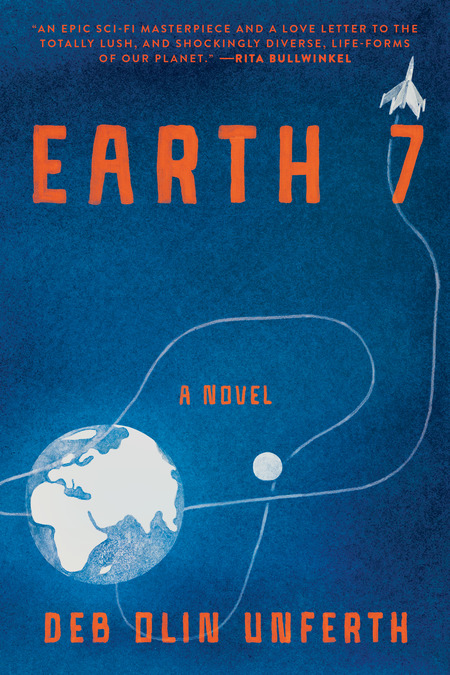
(courtesy Graywolf Press)
The end of the world, it will not surprise those of you who are studiously paying attract to the current deleterious drift of our planet into, variously depending on the news of the story, into climate change catastrophe, AI annihilation and fascistic governance, is very much on the radar at the moment.
It’s a lottery which of those three planetary ailments, or another one altogether, will eventually do us in, but Deb Olin Unferth has settled on a climate change as the culprit in her beautifully written novel, Earth 7, which takes us to an indeterminately future Earth where the environment is all but destroyed, very few animals and plants remain, and humanity has either escaped to live underground on Mars (it doesn’t sound all that enticing to be fair), is trying to eke some sort of garbage-surrounded living or has fled under the sea for some illusion of watery sanctuary.
The mother of the book’s protagonist, Dylan, an obsessed scientist named Rosemary who is a far better researcher than a parent (at which she fails abysmally), has chosen to take her daughter to live in a pod in Sea Gardens, an underwater grouping of housing which is supposed to offer a fresh alternative to the horrors of the maltreated land above.
While it holds a great deal of promise, the allure fades quickly for many of Rosemary and Dylan’s neighbours who leave in such numbers that any semblance of a community such a school excursions for a socially ill-adept Dylan soon come to an end, and she is left to dream of escaping to somewhere where the ocean most manifestly is not.
No, this was the story of Bubble Boy meets Plastic Girl. He falls in love with her, can’t live without her. Plastic Girl is not young, wild, full of adventure, like the ancestral heroines of screen. Maybe she was those things once, long ago, but not now. But to Dylan the world looked cold and ugly without her. Melanie was magic. And Dylan was, too, when she was with her.
Barely noticing her daughter’s resentment except when Dylan lashes out which happens increasingly often the more socially isolated she becomes, Rosemary is intent on realising some grand vision of a life not tied to an organic body and even when Dylan finally makes good her escape, her mother barely notices and takes years to come and visit her at a lab complex in the desert which notionally employs Rosemary.
So, on one level, Earth 7 is the story of a mother and daughter who don’t get each other, who are so diametrically opposed in outlook that even when they have a chance to see eye-to-eye they’re unable to take it, and who are eventually separated in the most fascinating of circumstances which speaks of the unbreachable chasm that lies between them.
Dylan simply wants to belong and to matter but growing up alone in a pod underwater with only her emotionally unengaged mother for company, she finds herself a socially awkward outsider wherever she goes, as reluctant to engage with people, rather ironically as her mother who takes her need to be alone to some truly extraordinary places.
The odd girl from the ocean, who spends her days as a groundskeeper at the lab complex studying the tardigrades that live between the granules, seems destined to forever be along; that is, until she meets Melanie who may or may not be a robot but who catches Dylan completely off-guard with the unexpected emotions she summons within her.
In a severely depopulated Earth, where the survivors are traumatised by past loss and a deeply uncertain future, Dylan and Melanie, after a near-miss or too, manage to forge a strangely devoted found family of sorts, all while various people around the Earth trying to build arks of a kind into which the almost lost genetic heritage of a ruined planet is poured.
The title of the book refers to Dylan’s own attempt to preserve as many of the planet’s life as she can, and it turns out, as various groups destroy the previously number “Earth” repositories (why is never clear; how much must you hate somewhere to erase the last trappings of much-maligned life?), her Earth 7 soon becomes the only record that certain animals and plants ever existed at all.
Told in a poetic but somewhat emotionally distant form – the author’s writing is for the most part sublimely good but her gift for gorgeously descriptive sentences falls prey to an emotional leaching of sorts – Earth 7 is a truly imaginative, very clever sci-fi novel which ponders how life and death can co-exist in weird ways that people somehow find a way to adapt to, and how skilled humanity is at compartmentalising life even as it appears to be staggering into an end game from which there is no coming back.
She [Melanie] rode for three days, the holy number, the number of haikus and jokes and pigs, of denials and wisemen and bears, of the faces of certain gods. At last she arrived at the final outpost in the desert. Beyond, only sand.
While it’s clever beyond words, and breathlessly incisive about the fractured state of the human condition, Earth 7 left this reviewer feeling a little cold and unmoved.
By rights, with so many momentous things going on, I should have been bereft for Dylan on multiple occasions, and while there was a profound awareness of how much she had lost in life, and how much she keeps losing even as she tries to fashion a life that makes sense to her, and I did feel for her in a few key occasions, the novel mostly left me strangely unaffected.
Clearly Deb Olin Unferth is deeply loved if the book jacket blurb is anything to go by – she is described as “one of our most original and beloved authors” – and her writing is some of the most beautifully poetic you will ever read, but while the words are artful and the storyline audaciously and pleasingly original (it’s hard to make the end of the world seem new but the author manages it) and even the characters are intriguing, it’s hard to feel much for people who seems so disengaged with each other and the world around them, and thus by extension, the people reading about them.
There’s no doubt that Earth 7 is a remarkably clever and thoughtful book which tackles a cliched event with original verve and thoughtfulness, but it ultimately failed to move this reviewer even when it became clear there was no coming back from the abyss, that hope was fleeting and ill-founded and that the only bright spot might be the very ark everyone else dismissed but which Dylan, in her weird uniqueness, one day thought might be important.