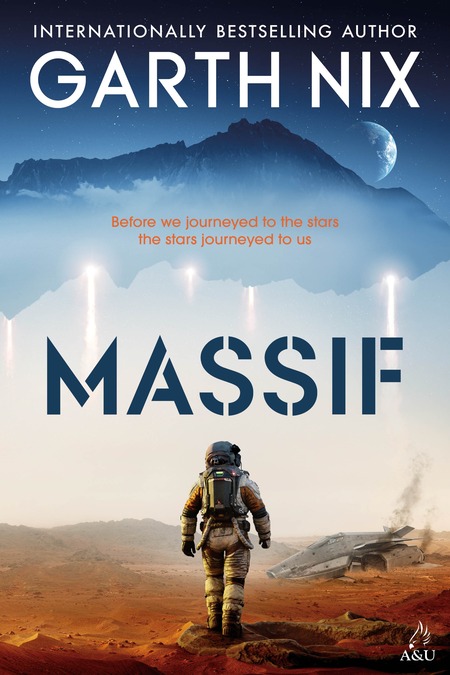
(courtesy Allen & Unwin – Australia)
One of the reasons this reviewer loves science fiction is because at its heart, it is devoted to exploring, thinking through and celebrating big ideas; woven into its storytelling DNA is an impelling need to peek behind the curtain, to wonder why things are and whether what we are seeing is all there is and whether there isn’t great substance, good, evil or otherwise, lurking below the surface that is treated, often through convenience, sometimes through conspiracy, as the only reality we have.
Many people don’t see beyond the conventional or the orthodox, happy to accept that what they see right in front of them, that serves them in some reason, even if it is just the dubious comfort of inertia, is enough, is everything they need, and as to the why of its existence, well, why trouble yourself with popping the metaphorical bonnet and looking underneath.
What is fascinating to a furiously compelling, page-turning degree in Massif by Garth Nix, is that while the central characters in his future space-based tale do dare to challenge the established order and think beyond the normal and the ordinary – though, you have to ask is riding into space aboard sentient mountains ever ordinary? Maybe not to us, but to many of the people on them? Weirdly, yes – they do so almost accidentally.
Ship Leader Parnell Shi-Sawalha – those with hyphenated names which is many of the people in the military on Earth, who are involved in a seemingly endless war with Martian colonists, are the result of intense, highly-targeted genetic manipulation – and his tight-knit crew don’t intend to shake the tree when they go rescue their downed Rider pilot Kaz from the planet below where a battle has occurred and shake it, denude it and send it crashing to the ground they most certainly do.
‘It’s a big galaxy out there,’ said Parnell weakly. ‘A big universe. We’ve only been out there for a couple of hundred years, we’re still meeting new Massifs, finding new routes, new systems. Those aliens could be anywhere out there.’
‘Yes,’ replied Conti. ‘ I tell that to myself too. Sometimes it even helps.’
They are not, as has been suggested, intentional revolutionaries. Or even really revolutionaries at all.
When their battle in a far-flung solar system, which like all systems the Massif of varying types, sizes and speeds journey to has a human-habitable planet at its core, doesn’t quite play out as intended, they have to regroup at their camp on the massif DrummingBoy (the names are drawn from a tic each of the Massifs have; in this case, an urge to tap out out an insistent rhythm) and work out how to convince a highly-bureaucratised ruling system to expend the energy, time and resources to rescue Kaz from the K-class planet in the system.
Parnell, Shille, Ricka, Bobb and Marud have to think quickly and out of the envelope to subvert a system so calcified and so unable to think of human society without massifs, that they need to prioritise finding a missing colleague over simply continuing business as usual which is centred on war for those with an occupation while the people of Earth exist in a world riven by climate extremes and an inequitable system that supposedly rests on the expending of social capital but which still seems to rest on capitalistic ideas like hierarchy, influence and class preference.
At this point in the story, Parnell isn’t really the sort to shake the system to the core.
He simply wants to save Kaz, find a new ship to call the Sassafras II and maybe, if the war ever ends, to find a nice planet, not Earth thank you very much where options are limited and possibilities few for civilians, for the whole crew to settle on.
What he isn’t counting on doing is subverting the expected order of things but when it turns out that he and the crew will need to do precisely that to find and rescue Kaz, he uses the very system imperilling rescuing their missing crew member, to leverage the time and resources they need to save someone from their found family.
What that leads to in Massif must remain the stuff of spoiler-free musing, but suffice to say that some of the big questions about the Massifs, the ones that almost no one thinks to ask though they always lurk on the edge of collective consciousness, such “Why do the Massifs carry humans to the stars?” and “What’s in it for the Massifs?” do get answered in ways that do dare to peer far below the surface of the accepted and the ordinary and which make Parnell and his crew realise that simply accepting that something is a certain way can often be the most dangerous accommodation of all.
So much so, that a blithely unaware humanity may be riding into a future in which they are not so much advanced as imperilled.
It could be a result of an attack by the enemy, but if so, it was the first time he’d ever heard of the Marsies attacking or even interfering with an emergency cache. Both sides respected the survival infrastructure of their enemy. Attacking a cache would be like shooting baggies in space, it simply wasn’t done.
What had happened?
The way that Nix, already acknowledged as a master storyteller for a variety of ages and genre types, answers questions that had danced through peoples’ minds but never to the point where they questioned the convenient, if militarily bloody, certainties of their spacefaring age, is absolutely compelling.
He does so not so much by brash, big narrative swings but by going small and intimate, concentrating on a devoted crew, their relationships and the lengths they will go to be there for each other and to ensure they remain together as what is really a familiar unit in all but name.
That in acting on behalf of one of their lost members they begin to pick the threads of a dark and dangerous state of being is incidental but oh what the ramifications are, again none of them arrived at by epic storyline twists and turns, but by staying in the seemingly small places of life where, if we’re honest, all the big things actually happen.
Massif dares to challenge the current modern need for storylines so big they feel Massifs themselves, happy to spin an immersively thrilling tale in the small but desperately important business of rescuing one person after an anything but run-of-the-mill battle and to let the characters and their close bonds be the drivers of what turns out to be a tree-shaking, life-changing, mind-blowing revelation of the darkness at the heart of a system none of them, in fact no one has, questioned up to the point.
Where Massif leads is thrillingly brilliant and told with exemplary reveals and scenes that seize the heart and the imagination equally, and you will not regret one second spent with Parnell and his crew who discover there is not only great value in looking behind the scenes and digging below the surface, but great life-saving necessity too, the kind that reminds us that questioning things may be the most important thing we ever do, even if it’s not what we start out to do.