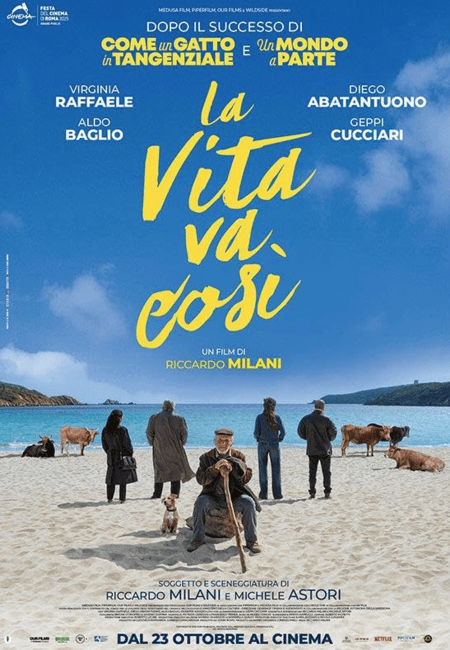
(courtesy IMDb)
If there’s one thing audiences love, it’s a David vs. Goliath tale.
In the real world, we sigh inwardly and rail with quiet fury, and often not-so-quiet fury, at the gross injustices of companies not paying tax and in effect screwing over the public they serve, fascistic politicians seizing power and them bludgeoning those fool enough to vote them in, and the tech bros who are forcing a march to AI on us that could drive us into oblivion.
And in the case of Life is Life (La vita va così), a powerful real estate based up in Rome and head by a President simply known as Giacomo grabbing prime beachfront land in southern Sardinia and developing a five-star eco resort right where a wizened and grumpy though innately thoughtful 80-year-old shepherd called Efisio (Ignazio Giuseppe Loi) has grazed his cattle ever since he inherited the land from his father (who got it from his father, and so on).
We feel powerless to do nothing, to effect any kind of real and lasting change that benefits the citizens against the faceless foes of a thousand big and brutal enemies, but in stories like the one at the heart of this film directed by Riccardo Milani to a screenplay co-written with Michele Astori, there is a chance that justice may yet prevail.
Though not, it must be said without the mother, or that should really be, the father of all fights.
Because sitting at the heart of Life is Life (La vita va così), which opened the 20th Rome Film Festival in 2025, is the story of two fathers, two men doing what they believe is right who are supported by two daughters who may not always agree with their fathers but who are, in the end, fiercely devoted to the men who dominate their lives and to whom they are innately loyal.
Efisio, who may appear comical with his small, slight frame and ever-present wooden cane, is looked after by daughter Francesca (Virginia Raffaele) who is exasperated by her stubborn father at times, but who doesn’t hesitate to make him meals so he eats well and as the battle between he and Giacomo heats up, stays with him so he is never without the support he needs.
Back in Milan, Giacomo’s daughter diligently studies economics and international management so she can follow in her father’s reasonably ruthless footsteps; theirs is a tight-knit relationship until Giacomo begins to waver ever so slightly in his pursuit of Efisio’s family’s ancestral land and she breaks away from him just enough to show she isn’t about to soften like her father has when she’s in a position to do something about it.
This father-daughter dynamic fills this comically rich tale, which isn’t afraid to paint the townsfolk as self-interested buffoons at times and impoverished people with reasonable grievances on another, which puts an affecting human face on what might otherwise just be a battle between big and small interests, both built into fiercely entrenched positions.
Milani does an exemplary job of creating two very distinct worlds with scenes which capture the essence of vastly different social settings with effortless and highly effective ease.
We are given plenty of time to walk down the dirt roads that lead Efisio and his cattle back and forth to the beach where they seem content to stand on the sand with not a lot of eating getting done; many of the walks are done in something approaching real time and we are able to settle into the rhythm of days filled with sitting on golden sands staring out into stunningly azure waters.
It is, without a doubt, a bucolic idyll but it’s one that is also framed by entrenched, centuries old poverty; Life is Life (La vita va così) rather cleverly, as noted, is happy to use the torches-and-pitchforks mentality of the villagers, who regularly walk to Efisio’s small semi-arid landholding to air their self-involved grievances, for impressively amusing comic effect.
But it also treats the great wealth divide between Italy’s industrialised north and its more economically deprived south with real empathetic sensitivity, bringing the villagers’ desperate need for an economic windfall in to real focus and helping us to understand why they are willing to jettison years of devoted friendship to Efisio and Francesca to get the hotel off the ground.
They can’t believe that Efisio, who could be seen as selfish for not supporting and advancing the common good but who is simply a man who loves his home and understandably doesn’t want to lose it, won’t accept the ever more astronomical sums of money being flung his way, and their outdoor “town hall” sessions where they advocate for what they need to a man who simply says “NO!” to everything give the film a comic element but also an evocative sense of what these people need which is a transformative break in life.
The titanic battle between Giacomo and Efisio, who meet one day on the beach on what turns out to be a life-changing experience for at least one of them, does end in a legal stoush, and an ending you will see coming a mile off but won’t resent for a second, but for much of Life is Life (La vita va così) the battle is between worlds and sensibilities, between what is and what could be, all underlined with the idea that just because something might be good for most people, it doesn’t mean the minority should yield what they need.
The thing is that while the resort might bring tourists and all kinds of business potential to the village, it would also mean Efisio would lose his land and way of life, Sardinia would lose yet more of its natural beauty to rapacious developers from the north and whatever gains might be had in an economic sense would be more than counteracted for the worse by the slow destruction of the local culture.
It’s a tough call when people are genuinely in need of a monetary boost to their lives, but Life is Life (La vita va così) keeps it simple, focusing on one man, his daughter, his cows and his land and saying that this matters too and that in an age where everything has a neo-liberalist value, maybe we need to start prioritising the simpler things in life and that perhaps we will all be better off if we do.