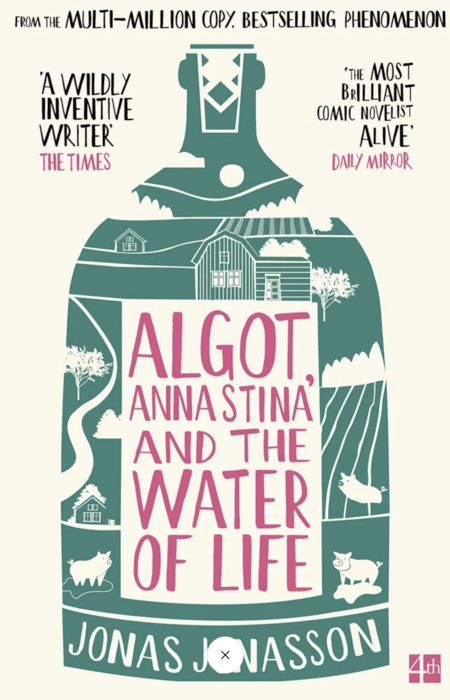
(courtesy Harper Collins Publishers Australia)
Reading has always been a great way to escape the world.
When all around you things go from bad to worse, and the nothing seems to be make any kind of meaningful sense, having a written story to escape into can make all the difference.
The absolute and complete joy of a writer like Jonas Jonasson (The Girl Who Saved the King of Sweden, Hitman Anders and the Meaning of It All, The Distinctly Competent District Councillor) is that he grants readers the chance to dim the harsh glare of reality, or even to turn it off altogether while rather cleverly skewering the person, idea or thing at the heart of the story he’s telling.
His books are also whimsically, wonderfully funny.
Very, very funny, and it’s a mark of his immense gifting as a writer that as you are laughing, smiling and slapping your thighs at the cleverness of his writing that you’re also being challenged to think hard about something via a morality tale of sorts, the kind where justice is always served, some weird kink or corruptive influence or wrongdoing in society is exposed and people are forced to consider whether what has always been done is necessarily the right thing.
It’s a wonderful mix of the serious and the silly and it is on full glorious display in his latest novel, Algot, Anna Stina and the Water of Life which takes us to mid-nineteenth century Sweden, and in particular the southern province of Småland where a cruelly, selfish and arrogant count is making life miserable for those under his cruel rule.
… the youngster at Kråketorp [Algot] seemed to be under the impression that being the son of a farmer was still relevant, even though his new position in the social order had moved him back eighteen pews in church on Sundays.
One of those people is the titular Algot, the son of a hog farmer who has built up his holding of pigs until there are close to 300 of them and he has even constructed an abattoir to process them when the time comes, along with the hogs of his neighbours.
Things are looking up for a man who, in becoming good at what he does, has earned himself a high standing and pew close to the pulpit in the local church; that all counts (ahem) for nothing when Count Bielkegren’s wife, French-born Antoinette, who bitterly resents being away from the Loire Valley, forced to live in the backblocks of what was then Europe’s poorest country (yes Jonasson serves up imaginatively fun history lessons too), decides she needs the hectare on which his hog farm and factory sit to exercise her pedigree Arabian horses.
The Count doesn’t love her – theirs is a marriage of political convenience, brokered, as many of these upper class marriages were for some advantage or another – but he wants to keep what fragile piece there is in Kronogården Castle and so after a simple request to pick up and go to Algot’s dead goes nowhere, he resorts to typically heartless and nefarious means to get what he wants.
In short order, Algot’s dad dies, he loses all the family’s lands, bereft of everything but a potato field, a dilapidated croft and a makeshift distillery, capable of churning out a local brew that no one but nobility is allowed to produce.

(courtesy official author site)
Algot does not have a lot of opinions in a time and place where the only place for someone like him is the poorhouse and the entire administrative machinery of society exists solely at the whim of the local aristocrat calling the shots.
But as Algot, Anna Stina and the Water of Life pivots to a world where Algot is but one of a mass of poor, opportunity-free and landless peasants, something rather remarkable happens.
The hero of our tale, who is smart and resourceful and eminently able to defy the very poor odds most distinctly not in his favour, masters producing schnapps which is, happily for his bank balance of precisely nothing, hugely popular with local railway workers who seem to exist purely on whatever alcohol is to hand.
At the same time as Algot is nailing being a businessman, he meets, by way of a cart and horse crash into a carrot field which suffers greatly in Algot, Anna Stina and the Water of Life and is the source of its funniest, throughput joke, a Bavarian printer Helmut, his half-Swedish daughter Anna Stina who happily defies any and all convention, a feminist well before her time, and through them a host of other remarkably memorable characters (a Jonasson hallmark) who become a found family of sorts who collectively change their lives, and inadvertently that of the Count (and not for the better; couldn’t have happened to a nasty autocrat).
‘The part where I [Algot] claimed to be an apothecary was just a joke,’ he said. ‘You have a sense of humour, Count Beilkegren, do you not?’
The count did not.
Witty to a cutting degree, buoyantly hilarious and happy to challenge any and all orthodoxy in its pursuit of ensuring the just getting vindication and the unjust get none, Algot, Anna Stina and the Water of Life is a gloriously funny and clever joy to read.
You are rooting for Algot, then Anna Stina and Helmut and the cast of characters who form around them, willing them all to succeed while the Count manifestly does not in a world where, historically the former has never succeeded and the latter, no matter their great sins, have always triumphed.
The fact that the usual corrupted way of things is upended, an order by the way that sadly still seems to persist in the modern where the rich and powerful have it all and those down the pecking order pretty much none, is a soul-reviving pleasure, a morality play writ large that is the hallmark of Jonasson’s novels which offer up a chance for characters to come out on top who might otherwise sink into sadness, loss and cruel obscurity.
There’s also some romance, quirky dialogue and wonderful twists and turns; Algot, Anna Stina and the Water of Life is an imaginative take on life in the clearly societally uneven surrounds of nineteenth century Sweden which gives you characters you won’t forget in a hurry, a plot which may seem haphazard but which goes places sharply observed and endlessly inspired, and a life lesson which clearly suggests that the rich and powerful aren’t that way forever and that it is possible to strike back and re-weight the balances of life and justice in favour of those who always been of it and who deserve it the most anyway.