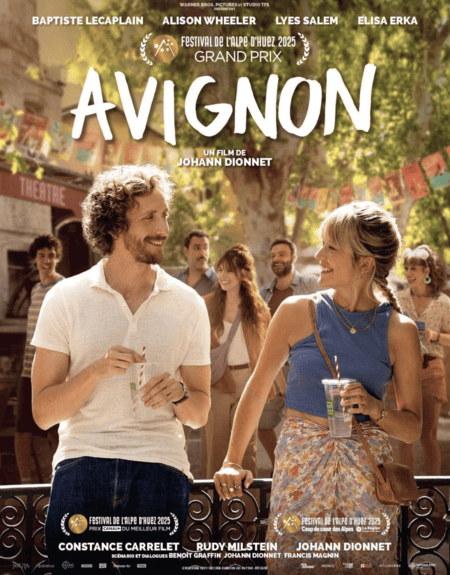
(courtesy IMDb)
Egos and love are all heavily in the mix in Johann Dionnet’s delightful French romcom, Rodrigue in Love (Avignon), which sees Stéphane (Baptiste Lecaplain), a frustrated but ambitious actor who wants to be known for far more than regional theatrical productions try to lie his way into the heart of the woman he has loved, or at least been heavily attracted to, for at least four years.
The object of hitherto unrequited affection is Fanny (Elisa Erka), a singer and actor who happens to be in Avignon at the same time as Stéphane and who comes to believe, thanks an assumption she makes which Stéphane doesn’t disavow, that he is playing the prestigious role of Rodrigue in the much-loved play Le Cid at the prestigious Théâtre du Chêne Noir.
The misunderstanding, which says as much about what Fanny values as it does Stéphane’s very naked need for validation as an actor, is the fuel that lights the fire of a romcom that may be all about getting the guy and the girl together, through all the usual hassles and obstacles, but which also goes deeper, exposing how smaller players in the French theatre scene often struggle for a higher profile at a festival with an almost overwhelming number of players.
Avignon has been around since 1947, and it is truly an awe-inspiring festival, taking over the UNESCO World Heritage City and turning it into one immense stage, where countless players and theatrical companies, some large, some small, compete for an audience which is almost spoiled for choice.
Competing with a throng of other theatre hopefuls is a small company run by the hot-tempered Serge (Lyès Salem) who has written what the French called a “boulevard play”, Ma soeur s’incruste (My sister is crashing the party), the central role of which was originated by Stéphane.
He and Serge do not have the easiest of relationships, with both men reaching for great success but not yet achieving it, a friction of ambition and thwarted that sees Serge leaving Stéphane out of the run in Avignon until he appeals to Serge’s wife and fellow company member, Coralie (Alison Wheeler) to intervene and get him reinstated.
Reinstated he is, but it’s more of a desperate lunge for something, anything for Stéphane who believes he is destined for greater things and that he should have a higher profile that Serge’s small company and play will afford him.
So, of course, when Fanny thinks Stéphane is in a far more prestigious play with a far better known company, it doesn’t take much for the languishing actor, who frankly has some massive ego issues, to go along with Fanny’s wholly misplace assumption.
While Stéphane’s attempts to give the lie life do make for a strong of very funny moments in Rodrigue in Love (Avignon), including increasingly bewildered from the actual cast and crew of Le Cid, it does create real issues with Stéphane and his friends who resent to varying degrees that he thinks he’s too good for them now.
But Stéphane is not the only disaffected member of the troop.
Serge and Coralie are going through one hell of a martial rough patch, exacerbated by the fact that the money Serge was banking one to fund the three-week run at Avignon could be in jeopardy, while the two remaining members of the longstanding company, Patrick (Johann Dionnet) and Amélie (Constance Carrelet), while happy to simply perform, can’t help but become embroiled in the tensions percolating fairly boisterously through the group.
Watching it all implode is the newest member of the company, Marc (Rudy Milstein) who is Serge’s nephew – Serge is loathe to admit this to anyone but they all figure it out fairly quickly anyway – and who is there to do all the admin stuff, though to be fair he isn’t all that good at that to begin with.
As much a love letter to the Festival d’Avignon as a romcom and a spotlight on creative scale and ambition, and the tensions between those who act to live and those who want far more from their thespian pursuits than a warm creative inner glow, Rodrigue in Love (Avignon) is a real joy.
It’s ending may more than a little cliched and seemingly come out of nowhere, but there are some real moments of connective substance through the film, especially in the way the members of Serge’s company mostly see what they do as the calling of a family, a dynamic and belief that persists even through the more tension-filled episodes of the narrative.
While Rodrigue in Love (Avignon) definitely has its eyes on its romcom prize, it also generously gives a big slab of its run time over the machinations within Serge’s company, to the more intimate moments between various characters, all of whom are reasonably well fleshed out, and to the great pull between creativity and ambition, always asking if the two can coexist?
Its various competing foci may seem like they couldn’t exist together in the same film, especially since romcoms generally have no air in the room for anything other than love, sweet love, but Rodrigue in Love (Avignon) makes it all work and work in such a charming way that you get to the end of the film and forgive a few of its late-in-the-story indulgences without barely a thought.
That’s likely because the film goes to great, immensely pleasing lengths to create a real sense of time and place, of family, art and community, and while, yes, it very much wants Stéphane and Fanny to get together, despite the considerable obstacles in the way, it knows that their connection will only make lasting sense and have any real impact if it takes place against an emotionally and creatively meaningful backdrop.
After all, it’s what drives the two principal people in the film and why there is any power in the storyline, sometimes farcically and hilariously so, is down to the film’s embrace of a love of theatre, of the people who bring it vigorously and joyously alive, even at great personal cost, and its understanding that given the right circumstances, ambition can give away to the primacy community and family and, rather happily for this charming romcom, love.