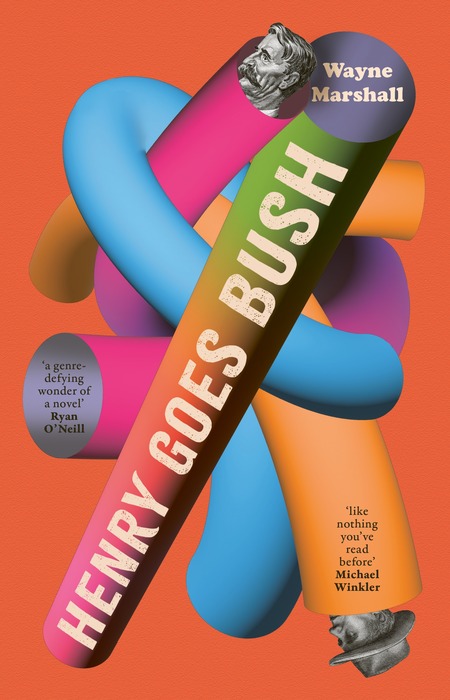
(courtesy Pan Macmillan Australia)
There are certain figures who are so intrinsic to a country’s modern identity that you automatically assume you know everything is about them.
But as a fantastically imaginative and thoroughly clever new novel, Henry Goes Bush by Wayen Marshall, makes clear, that’s not always so.
The novel’s titular protagonist is bush poet and writer Henry Lawson, a man central to modern Australia’s identity, who has been called the country’s “greatest short story writer” and who, along with his equally well-loved and famous contemporary, Banjo Patterson, is renowned as someone who played a pivotal role in the idea that Australia is a country shaped by the bush and by the hardy types who spearheaded the colonial settlement of the then-new British colony throughout the 19th century (it’s important to note here that this land was never ceded by the country’s Indigenous populations and that many people see this not as a settlement but an invasion).
The real Henry Lawson, the one not bound by myth and legend, had a great many problems to contend with, including a problematic childhood with parents who had a deeply unhappy marriage before their split, chronic alcoholism and an inability to sustain any kind of healthy romantic relationship.
He has also had, it is reputed, an intense relationship with fellow bush poet Jim Gordon, who wrote as Jim Grahame, one, of course, that could never have been openly declared in fact it did exist as any kind of gay love affair.
At the same moment in another Bourke, another Lawson is back on the beers with Chapman and Langwell. In another Bourke, another Lawson walks hand in hand with the barmaid down the stairs of the rollicking Great Western. In yet another Bourke, yet another Lawson rises to applaud the actors taking their curtain call for the matinee show at the Lyric, locking eyes with Jim Gordon along from him and blushing again.
All of that is noted, as indeed it is in Henry Goes Bush, simply to say that it’s impossible often to separate fact from fiction, the man from the mythos and we are often revering only a partial idea of a person when we venerate them as an important cultural figure.
What is so brilliantly refreshing about Henry Goes Bush is that Marshall doesn’t necessarily try to fill in the gaps, though he does alternate, for part of the novel at least, his increasingly outlandish tale with recounting what historians and commentators know about Lawson generally but more importantly for this book, about his time in Bourke, NSW in 1892.
Despatched there by JF Archibald, the founder and editor of The Bulletin magazine, for which Lawson was a major contributor, writing mostly about the growing myth of the bush, his work written in rivalry, which may have been, may have been not, with Banjo Patterson, Lawson was supposed to dry out, get to know the real Australian bush and to measure up to the myth rapidly accreting around him.
Lawson, essentially press-ganged into going to Bourke and none too happy about it, resented his enforced sojourn in the bush which he supposedly didn’t like, unlike Patterson who embraced it, it is said, with a genuine affection Lawson lacked.
While history records the bush poet’s time in Bourke as a trip that defined his career, Marshall has some altogether more out there ideas which, while they arrive at the same point, that Lawson was better for his interregnum in the town, don’t hew too close to what is historically known about the man.

(courtesy Pan Macmillan Australia)
But that is part of the fun of this incredibly adventurous and audaciously thoughtful book which asks us to consider whether what we know of history, of a man and his place in it, can ever truly be known.
In fact, in one extended series of chapters in Henry Goes Bush, Lawson himself has to outrun his own legend which comes alive, with some jaunty multiversal cleverness, and challenges him to account for who he is and the kind of man he wishes to be known as.
Marshall, rather inspiringly, also turns the rivalry between Lawson and Patterson aka The Rider, into an actual gunfight on the banks of the Darling River which flows through Bourke, with Patterson, far more adept at being the legend he is being shaped into, coming out on top until Marshall’s richly imaginative story turns all of that somewhat on its head and makes Lawson far more of a well-realised man than he had been up to that point.
While the back cover blurb says the trip to Bourke is rendered by Marshall “as a surrealist action movie”, and true it often feels like a fever dream writ hypercolour large, at its heart Henry Goes Bush is an exploration of how the weight of societal and literary expectation and the demanding attention of a public eager for a writer to tell them who they are can make life all but impossible for the person at the centre of the myth.
And he [the Rider] wondered, not for the first time, with the full force of epiphany: if this was how he felt at the intrusion upon his beloved bush, how must it have been for those whose existences were inextricable from it when, on the waterways and between the gum trees and across the paddocks, the Europeans came?
While there is a great deal of actual historical retelling in the book, the unique narrative approach of Henry Goes Bush means it can take all the various interpretations of and ideas about Lawson’s life and play havoc with them in the best possible way, all servicing the idea that Lawson was a man being consumed by a mythical idea of himself of which he had no wish to be a part.
In Henry Goes Bush this battle between man and myth takes varied forms, all of them presented as various versions of the same period where Lawson either fell prey to his demons, of which, as noted, there were many, or in one singular storyline which owes a great deal to imaginative magically real elements, in which he has a better than even chance of being the one who comes out on top.
A book with a fantastical premise and very serious intent which is realised with incisive thoughtfulness and not a little empathy, Henry Goes Bush is at its heart a very human, multi-genre book in which the man Lawson actually is, and who he might become, is allowed some room to breathe and be, free, for a short while at least, from the pressure of being a famous figure shaping the identity of a new and eager nation (and one, it is noted, with some darkly fascistic leanings too).
Reading it is in many ways a romp and a garrulous adventure, but one with a serious and intense soul which threads all its out there narrative ideas and seamlessly inventive execution with a serious look at how myth can consume the man, of the fact that we can never truly know an historical figure and that perhaps there is a real reward in simply letting someone be even if that happens in the most fantastical way possible.