(courtesy IMDb)
Coming to a crossroads, especially an unexpected one, where you have to deal with the fact that something you believed in is no longer worth supporting or is not even remotely what you once believed it to be, is always a jarringly existential moment.
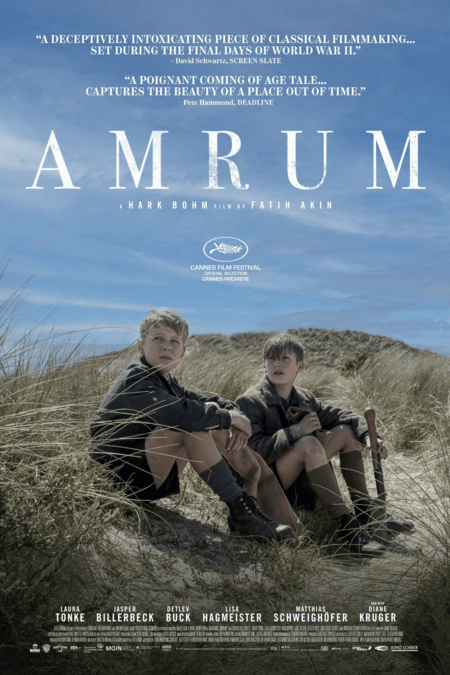
It can absolutely knock an adult of their feet, but if you’re a twelve-year-old? It can feel like the end of the world, which is exactly what it feels like for Nanning Bohm (Jasper Bilberbeck), the affecting protagonist of Amrum, when he has to confront the fact, in the dying weeks of the Nazi regime, that the belief system that has underpinned his young life is manifestly no longer fit for purpose. (Of course, if you’re a sane adult with a beating empathetic heart, these horrific beliefs were never fit for purpose but that’s a whole other discussion to have and certainly not with a six-year-old already reeling from the abrupt end of his “truth”).
But for this incredibly pre-possessed young man – he may be staggering under the weight of monumental change but he still retains the nous and tenacity to respond to it in a way that makes sense to him; more on that later – it is less a loss of belief in a then-prevailing set of beliefs, than the fact that his mother Hille (Laura Tonke), the wife of a “Nazi hotshot” (as someone else in the film describes him with more than a little acid), can’t cope with the loss of the beliefs that have driven her life, likely for over a decade.
She has just given birth to her fourth child on the remote island of Amrum of the north-west German coast where she has fled after bombings began to impact their stately home in Hamburg, and is dealing with what appears to be a fairly intense case of post-natal depression.
When she and the rest of the household, which includes her sister non-nonsense sister Ena (Lisa Hagmeister) with whom she co-owns the family’s nine-generations-and-counting ancestral house, received word that Hitler has died, Hille sinks even further into depression, refusing to eat, which would normally be a sizable issue anyway but which becomes more pressing since she has a newly-born daughter to feed.
Her only wish, and it’s clearly uttered as a throwaway line since she doesn’t really remember saying it lately, is to eat some white bread (in short supply because wheat is being used as a medicine on the front line) with butter and honey (both also incredibly scarce), and since it’s the only thing she expresses a desire to eat, Nanning takes it upon himself to locate all three things and give his mother her heart’s desire.
If Nanning had thought to check with Ena, he would know that what Hille really needs is meat but he’s a kid and so he goes with the obvious, spending huge amounts of time, and placing himself in not a little danger, to source the wheat, honey and butter he needs and to bring them all together for a treat he believes in his young, charmingly uncomplicated worldview will life his mother out of his despondency.
As explorations of the death of one belief and the slow traumatic move to another, and it’s never a smooth or easy process and never as complete as we might wish it to be, Amrum is a masterpiece, quietly and with impressive nuance, taking us on Nanning’s journey, and to an extent Hille’s too (by way of an adult reaction to graphic changes in the fortunes of their family and that of Germany as a whole) to a place where the world is being remade in ways this young boy knows are different but which he doesn’t fully understand.
What is essentially an autobiographical depiction of famous German filmmaker Hark Bohm – who appears in the film’s final, silent and quite moving scene as an octogenarian staring out to the sea which surrounds Amrum – who wrote the film with acclaimed director Fatih Akin, Amrum dares to ask what happens when the world you knew and which you believed to be right and solid and enduring is not only toppling slowly before your eyes but also being called into disrepute by those who no longer have to silence their dissent.
He first comes across someone who doesn’t tow the party line when his employer, a local party farmer named Tessa (Diane Kruger in fiercely masterful form), expresses acidic relief that at least the war is ending soon and they can stop pretending to care about all the Nazi ethos, and from then on, he sees that while his mother is keeping the faith, precious few others on the island are.
As he comes across death again and again in various forms, he has a dream where he meets his U.S.-based Uncle Theo (Matthias Schweighöfer) on the beach at Amrum and has a chilling conversation where Theo, who lost his presumed Jewish fiancée to a concentration camp – Hille and her husband, Wilhelm, a SS-Obersturmbannführer (lieutenant colonel) could have intervened but chose not to – says that while he doesn’t carry guilt for the terrible things his parents have done, he is inextricably a part of their legacy and the host of issues that follow in its wake.
While again Nanning is just a kid, he begins to appreciate that there is far more going on than some white bread, butter and honey can fix, but his level of cognition is such that that solution is the only one that makes sense to him and so he perseveres in realising it, and in so doing, learns more about his mother’s ancestral home, his fellow islanders (though he is still considered a mainlander) and the life they fiercely protect.
Amrum is a masterfully realised film, full of stunningly evocative landscapes, quiet scenes that roil with intense emotionality and a host of pressing ideas, and performances which bring to light and life what happens when one set of beliefs end, and violently so, and another begins, and a family, and indeed a whole nation, have to adapt to a vastly changed and traumatically arrived at new reality.