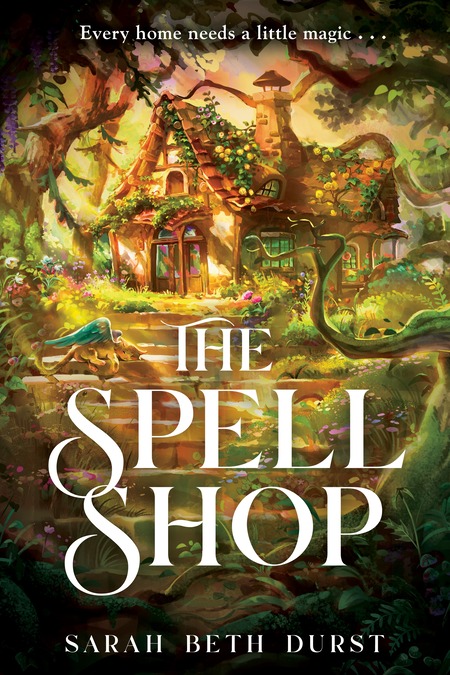
(courtesy Pan Macmillan Australia)
“I wanted to write a book that felt like a warm hug.”
Reading that sentence in the Acknowledgement section of The Spell Shop by Sarah Beth Durst was not only delightful because who doesn’t know want to know the author of a book they loved actually set out to make you feel exactly as you are feeling at the end of the book – mission well and truly, and happily, accomplished – but an affirmation of a book that quite simply feels like the shot in the arm you were really needing.
There are those who, rather mysteriously and confoundingly, despite the idea of cosy, as if it’s some sort of low rent Disneyesque piece of nothingness worth anyone’s time, but I’ve never quite understood that mindset because in a world full of reasons to feel anxious and afraid and frankly downright terrified at times, being given the gift of cosy happiness has to be one of the loveliest and most precious things ever.
Certainly, when you’re reading The Spell Shop you’re reminded of how fleeting that feeling can be, but how if it persists, as it does for the book’s beleaguered-turned-joyfully-hopeful protagonist Kiela, it can change every last part of the world as you know it.
And ever anyone needs the power of cosily transformative, it’s librarian Kiela who, as the novel starts, is fleeing a revolution in the capital of the Crescent Islands Empire which has gone completely out of control, as these pent up conflagrations are apt to do, and set fire to the Great Library of Alyssium, her workplace and home of many years.
Looking at what they had and didn’t have, Kiela didn’t see any way around it. It was foolish to think she could build a life here just from what they found and what they brought. Besides, the fantasy of living unnoticed had already been broken when their neighbor [sic] had discovered her sleeping.
No, there was no denying it.
She was going to have to talk to people.
With her wisecracking but heartfelt sentient spider plant friend, Caz, the two flee their section of the library with almost five crates of spellbooks, with their only goal to return to the island where Kiela grew up and where her parents’ abandoned home still hopefully sits.
They left years earlier for the bright lights and cosmopolitan delights of Alyssium, but with the capital now aflame, the island of Caltrey seems like the safest place to shelter in a fiery storm that has robbed introvert Kiela of her snug and cosy home, her mission in life, and her sense of self and place.
That’s a lot to lose, and as Kiela and Caz arrive on Caltrey, she simply wants to lock herself away, talk to no one, and protect her precious books of which she laments she has saved too few.
But life has other ideas, and as The Spell Shop gets into high gear, Kiela finds herself connecting with her childhood friend – though at first she can’t remember him, though he can certainly remember her – Larran, who her merhorses in the surface of the island as he fishes its bountiful waters, and baker Bryn who, like Kiela arrived in her chosen sanctuary some years before to find a home for her and her nephew.
Is it though going to be the home that Kiela remembers and frankly desperately needs?

(courtesy Pan Macmillan Australia)
Of course, it will, but the real joy of The Spell Shop is that it doesn’t simply tick off the expected boxes like some rote fantasy-telling exercise.
Yes, Kiela builds bonds and a sense of community with Larran (well, much more there but hey, you saw that coming, right?), Bryn, and a host of other lovely people who fight for her and their newly-enlarged community when trouble comes a-calling, and her slow-building mastery of the spells in the books she saved remakes her new home in some fairly profound and nurturingly intense ways, but the way Durst spins these expected elements surprises and delights at every turn.
If you have ever felt like you’re on the outer, and that it’s the only place you really belong, you will feel a real sense of relief, reluctantly given up because when you’ve been hurt, letting down those walls is TOUGH, as Kiela does, that maybe you have finally found a place where you can be yourself and be truly, cosily safe.
That certainly happens for Kiela, and as she embarks on a new life as not only a keeper of spellbooks, a waver of magic and a Caltreyan renewed, she is surprised to discover that while erecting high emotional walls might keep you sort of safe, it’s not any real kind of life.
Reading as Kiela slowly lets down those walls and invites a host of beautiful people in, who stand guard over her when less-lovely people come sailing into the island’s harbour, and even they turn out to be people in need of love and understanding too, is one of the best things about this wondrously good book.
Kiela laughed and kissed him again and again, as the waves kissed their bare feet and the sea breeze danced around them and the sun shone down — and it all felt so eternal and so ephemeral at the same time.
The Spell Shop is proof positive that a cosy read doesn’t mean there is no emotional heft or resonance.
In fact, as Kiela and Larran grapple with their respective experiences of past trauma, Durst doesn’t stint for a second on how much this has scarred them and it adds so much depth to a book that embraces hope, love and community with gusto but which also acknowledges that that is not the natural state of the world and that often getting to a state of inclusional cosiness is something that requires grit, determination and the most harrowing of journeys.
But these characters, and others besides make to that most wonderful of destinations after some scary moments of the soul and the intervening of unpredictable outside events, and we are lucky enough to be there as difficult, weight steps suddenly become light and joy-filled.
If you need your heart lifted in a lasting and meaningful way and want to spend time with characters who do the hard yards but find that the end of the road leads to a lightness of the soul and happiness they never thought could be theirs, then The Spell Shop needs to vault to the top of your TBR.
Trust me – you will endlessly glad you did.