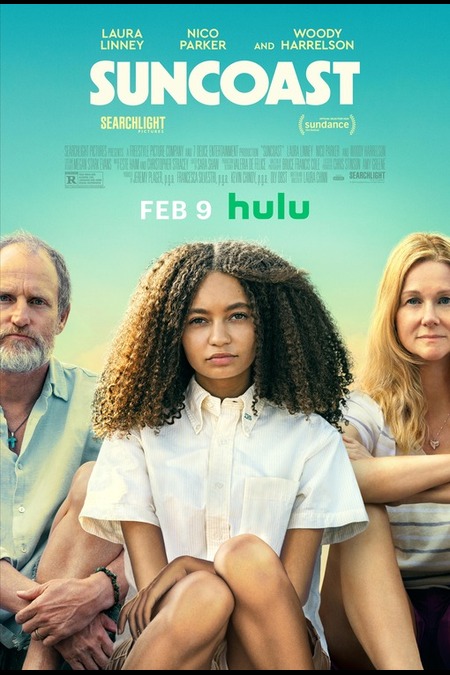
(courtesy IMP Awards)
Growing up, and especially starting on the transition to adulthood, is never an easy thing at the best of times, but when you’re life is not “normal”, not even close to it, (and that’s leaving aside the fact that the very idea of normal is a rubbery and relative concept) then it’s becomes a whole other level of complicated.
Not to mention emotionally wearing and sadly inhibiting, which is where Doris (Nico Parker), the protagonist of Suncoast, finds herself as this gently searing film about getting lost in impending loss and grief can derail the lives of living even when they steadfastly want to be there for ailing people they love.
Doris’s brother Max (Cree Kawa) is in the end stages of brain cancer, requiring constant care which often falls to his private school educated sister who has no friends, no social life and not even a hint of normality (or at least the way she defines normal, anyway) and who has a fractious relationship with her mum, Kristine (Laura Linney) who is obsessed with Max’s care to the exclusion of all else.
That makes sense, not simply because she is a mother who deeply loves her son, but because, pulled away from him often to the restaurant job she needs to pay a host of neverending bills, she feels guilty that she isn’t there to care for Max 24/7 and overcompensates when she is present, demanding that everyone and everything subsume their wants and needs to looking after Max.
That’s where the pressure falls onto Doris who, though she loves her brother and is grief-stricken he is dying – though that often is lost in the simmering resentment she feels at being forced to be an adult way before her time – isn’t happy that she can’t be a normal teenager because of the incessant demands of Max’s round the clock care.
It’s at this point that Doris meets Paul (Woody Harrelson), a Christian widower who, along with many others, is picketing the hospice where Max is spending his final days to protest what they see as the impending “murder” of Terri Schiavo, whose case has attracted the ire of many people who oppose euthanasia and who argue that the right to live supersedes all other considerations.
Wise beyond her years, and understandably so given what she has to contend in her 17 brief years on this earth, Doris hears Paul out but counters with the fact that you can’t possibly know what is going on for someone and what they’re facing unless you’ve been through it yourself, and that it’s a whole different scenario when the hypothetical becomes the very real.
Her unusual and brief friendship with Paul, which always feels a little half-baked though still meaningful enough for the demands of the sometimes slight story, gives Suncoast the chance to riff on some highly emotional but incisively thoughtful ideas about death and dying.
But while she and Paul do have some interesting discussions, and he provides some support to her including teaching her to drive which gives some sense of normalcy in a life that is anything but, they never really feel like they have any impactful weight to them.
Touching yes, and certainly at the end when Max has did (hardly a spoiler; that is flagged well ahead and you know exactly where the film is headed) Paul is there for Doris in quietly nuanced and touching scene, but you could talk Paul out of the film and Suncoast wouldn’t really have suffered much as a result.
Where Suncoast does really knock it out of the park in a fairly conventional, tick all the boxes story, is in the way it absolutely nails what it’s like to start mourning someone before they are gone.
When my mum was diagnosed with ovarian cancer and decided, for a host of well informed reasons not to pursue any form of conventional treatment, the clock began ticking and the whole family entered into a bizarre but understandable state of proto-grief, or anticipatory grief, ahead of my mum’s actual death.
It’s an odd place to live because you are with the dying person and trying to be as normal as possible but of course life at that point is anything but normal and you know that as soon as she goes, grief will descend savagely and relentlessly on you.
It’s like waiting for the worst of all shoes to drop and it wears you out and grinds you down (even though being there for your loved one is a great privilege and I am so glad I was able to be there for my mother) and so, you can understand the pressures that Doris and her mum are under and why they crack under the pressure more often that they don’t.
In that respect, Suncoast is confronting but also necessary because it reminds you that we lose dying loved ones twice – first when we know they have an incurable condition and that what looked like limitless time with them is horrifyingly finite and the secondly when they actually die and all that anticipation of their loss becomes deafeningly real and final.
While Suncoast does completely knock it out of the park, with some of its scenes not really sticking the landing, by and large it does a beautifully nuanced and quietly paced job of exploring what happens to the living in the gathering twilight of someone else’s life.
While Doris does make some friends including potential love interest Nate (Amarr) and even goes to parties and the prom, allowing some normal to creep in, neither she nor her mother can really live the kinds of unburdened lives that many of us take for granted, and it’s only at the end of the film when Max has died, that they begin to emerge into something that looks sort of like life.
Well, at least its very earliest beginnings; if there’s one thing this quietly lovely and emotionally honest film does quite well, it is admitting that normal never really exists for any of us and that whether we are lost in proto-grief or the full blown deal, and let’s face that’s a lot of life accounted for there, we are always trying to come to grips with life’s often horrific ups-and-downs, made all the harder when life itself has barely begun for you.