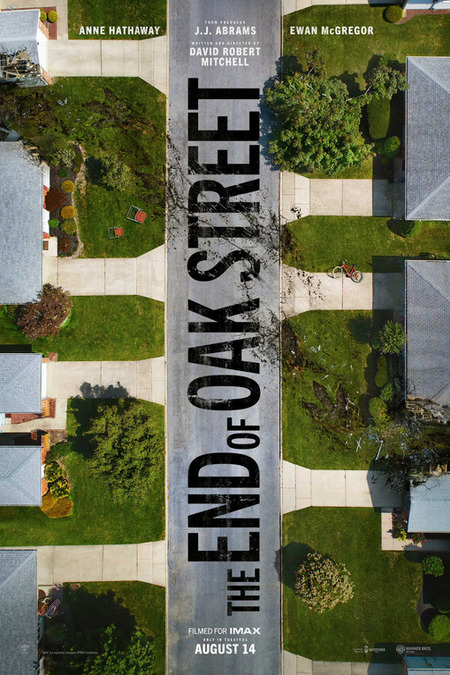
(courtesy IMP Awards)
It’s likely one of the greatest tests any person can face – what do you do when your world changes, literally in an instant, and you have to confront and deal with a brand new set of circumstances with no time to prepare and no real understanding of what you’re up against.
Does it prove what someone is really made of? Possibly, but what it does do beyond a shadow of a doubt, and this is one graphically immersive display in The End of Oak Street, is demonstrate how much the human spirit can bear, especially when it is bolstered by the unconditional love and support of family.
That theme has always been a significant one for directors like Steven Spielberg who has almost singlehandedly brought into being a retro-heavy genre – now it is; back when he started filmmaking, it was simply a product of the society of the ’70s and ’80s – where terrors aplenty and horrific challenges without number are met and mastered by people who are, yes, scared and way in over their head but who band together with those they love to make it through to the other side.
Set in a typical suburban landscape in 1982, The End of Oak Street is very much a product of this Spielbergian approach to creating heartwarmingly intense blockbusters, going big after a deceptively slow and nuanced start which sets the scene and builds anticipatory suspense with masterful ease, and taking us, and the Platt family at the heart of the story, back 200 million years to a time when Earth was full of swamps and dinosaurs and a dearth of anything resembling civilisation.
Denise and Greg Platt (Anna Hathaway and Ewan McGregor respectively) are teetering on the edge of divorce, with the former writing a novel in secret down in the basement of her family home while her husband delivers pizzas, something which embarrasses a woman who is very much the heart and soul of her community.
The movie opens on a bucolic scene with the neighbourhood celebrating summer with a block party where people are barbecuing, kids are playing and people are taking the time to shoot the breeze with people they might normally not see or interact with.
But that sense of summer ease is tinged with weird and unease-inducing goings-on in the vicinity of Oak Street where a 200-million-year-old and definitely extinct plant suddenly grows in the backyard of the Platts’ kindly old neighbour Mrs. Huddleston (Anne Gee Byrd) who is editing Denise’s manuscript and a massive pile of stinky, fly-covered dung appears in the backyard of the Platts’ neighbour, Mel Jacobs (P. J. Byrne) who is angry about everything, including the frequent intrusions of his neighbours’ dog Starbuck (a nod to Battlestar Galactica, one of many pop culture touchstones in the film) into his yard.
Add in unusual solar activity and you have the stage set for something truly odd and strange to happen to Oak Street which it duly does when a circular slab of the neighbourhood swaps place with a similarly-sized wedge of prehistoric swamp in which all manner of giant beasties dwell.
It all happens around 11.05 one night and while the Platts are awake to notice it, many of their neighbours are not and The End of Oak Street makes merry with what happens when people blithely walk out into a changed world not unsuspecting that business as usual is not even on the table anymore.
The body count is high and it is messily bloody, though the film rather cleverly ducks and weaves around much of the violence by using suggestion and quick cutaways before turning to maimed or munched-on bodies and corpses lying in the street.
A lot of their neighbours are slow and quick-to-die members of an ever-escalating body count, but not the Platts who, though freaked out of their brains, and how could you not be when the streets and yard of your neighbourhood are now filled with Allosaurus, Spinosaurus, raptor-like Coelophysis and a host of other dinosaurs, pterosaurs and giant snake-like reptiles, rally and prep their home to deal with a massively different world perilously right outside their door.
While their initial plan is to bunker down and hope the neighbourhood bounces right back to good old 1982, a plan by the way riven by dissension by a bickering Denise and Greg who differ on how optimistic they should be and whether they should be preparing for this to be their new forever home, a series of events, driven by ill-thought-out but understandably emotional decisions by their children, Audrey (Maisy Stella) and Brian (Christian Convery), send the family out in their new dangerous home and out them in cinematically gripping harm’s way.
There are, of course, the expected series of threatening moments and mortality-challenging near misses, and these are executed with all the pulpy adrenaline pulping action you could ask for, but in the middle of these brilliantly executed, masterfully-CGI’d moments, there are scenes of intense emotional intimacy and raw humanity which see every member of the Platt face some very dark moments but ultimately pull together as the team they haven’t been for quote some time.
It may seem corny to say that facing up to all those ancient animals is the making of the family but it transforms them, very quickly wiping away all the fractious divides between Ben and Denise and reminding them why they fell in love in the first place and how lucky they are to have the rich and wonderful family they do.
As therapy goes, it’s a doozy of an approach but it works, serving up horror and terror, pain and fear and harrowing loss but also a sense of a future which may be better than anything they conceived of back in 1982.
Possessed of an imaginatively far-fetched ending that should be all kinds of cheesiness but somehow feels like a thousand kinds of heart-stopping and heartwarming Back to the Future-ish feels, a tight and taut The End of Oak Street is BRILLIANT – you get all the expected dinosaur thrills and spills, and the sort of real world violence not even Jurassic World managed as well, but you get huge helpings too of Spielberg-level ‘80s-set humanity and heart in a film that knows the world, especially one 200-million-years-old can be dangerous but that it’s nothing that love and family can’t handle when put suddenly and traumatically to the test.