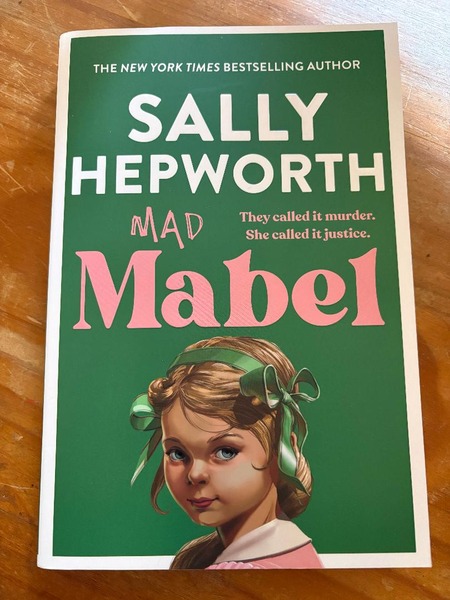
As a reviewer who knows a metric ton of books in a year, I have come across a few “second chances” books in my time, stories which ask what might happen if socially isolated or broken people burdened by past mistakes were given the opportunity to remake their lives (deliberately or inadvertently).
Many of them are endearingly heartwarming, driving home the power of love, community and unconditional inclusion and support, and how the presence of some or all of these things can powerfully change a lost person’s life for the unequivocal better.
Among the multitudinous denizens of this genre, Mad Mabel by Sally Hepworth definitely stands out as one of the very best, and likely one of the standout novels of the year.
All the usual tropes and cliches have been ticked from the person with secrets, burdened by past trauma and loss, discovering that the people in her small street of terraces love her unconditionally and are there (eventually in some cases, but there nonetheless) but oh the way Hepworth builds and sculpts them into something quite arrestingly, substantially and affectingly original, a tug on your heart that won’t go away and which persists because the story of the novel’s protagonist really carries impressive emotional weight.
The titular Mabel is an 81-year-old living in a terrace house in a cobbled street called Kenny Lane on the edge of central Melbourne in which only six houses remain, meaning that everyone knows everyone else, and like any small town, pretty much each other’s business too.
OOOO
While Mabel, now known as Elsie Fitzpatrick, has lived on the street for sixty years and think she has flown well and truly under the neighbourhood radar, when her next door neighbour is found dead in his home, his endless vitamins shipments piling up on his doorstep, is quickly emerges that she is the infamous “Mad Mabel”, who in 1959, was the youngest person ever convicted in Australia of murder.
Her reputation, which quickly turns Kenny Lane into a media circus and alarms some of her neighbours before they regroup and rally around her, soon means the police are hot on her trail and all the trauma she thought buried many decades behind her, have risen from the grave to haunt her once again.
Elsie/Mabel has two choices – sell up and run or finally tell the world what really happened back in the 1950s and why she is not the monster of popularly infamous reputation.
She opts for the latter, but not without some second thoughts, understandable given the media spotlight suddenly shone unrelentingly on her, and decides she will talk to two YouTube influencers, Libby and Adeem, to set the record straight and to free herself from the burden of a past shaped by others, including her malevolently cruel father, and never by herself.
It’s time for Elsie, who is far from being your typical old lady, both in build and temperament, to take back her story and to seize control of her life and its much corrupted narrative.

(courtesy Pan Macmillan Australia)
The telling of her life story on her terms takes the form of “Then” chapters which document, in harrowing and poignant detail, how she has always been the product of other peoples’ perspectives and hateful assumptions and that she’s been burdened by lies, rumours and made-up stories which bore no resemblance to any reality.
It’s a lot for any person to bear, especially for someone who has borne such a great weight throughout her life, but what makes it survivable and in the end empowering is the community, the found family that coalesces around Elsie/Mabel, people who, for the first time in her life, choose her for who she is and not who she is reputed to be.
Mad Mabel then is intrinsically the story of how powerful it is when we love and support someone and choose their truth every time over the scuttlebutt and lies that swirl around them.
For Elsie/Mabel it is life-changing as she reluctantly ends up as a surrogate grandmother to seven-year-old Persephone, daughter of Roxanne who fears her neighbour’s reputation until it becomes patently obvious it bears no resemblance to the truth at all, and as neighbours Peter, with his love of Aldi bargains, Joan who loves a good gossip and the Nguyens surround her with the kind of loyalty and love she has always craved but never found except from her much-loved aunt Cess and her girlfriend Ness (though in the 1950s, that was all kept under wraps … until it wasn’t).
OOOO
OOOO