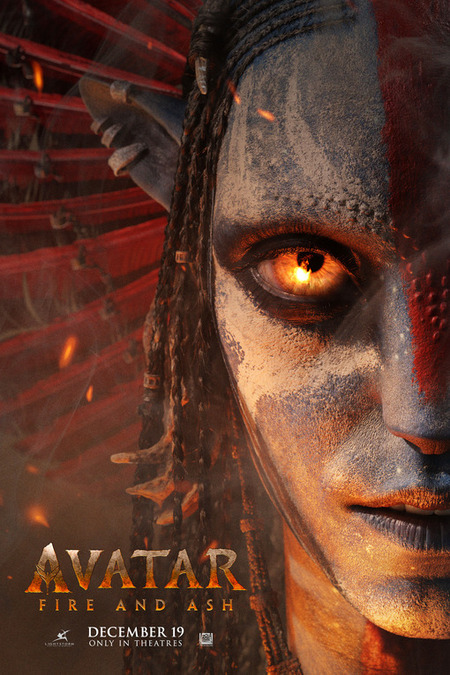
(courtesy IMP Awards)
Reviewing a major Hollywood release almost a year after its initial release might seem like an oddly delayed thing to do in our hyper immediate world where the zeitgeist is super focused on something one day and curiously uninterested the next.
Truth be told, the delay in this instance, in direct contravention of riding the wave of the new, the hyped and the (hopefully) exciting) is due solely to the fact that many of these huge blockbusters hit local screens just before the Christmas/Summer holidays, and while that means lots of time for most people to hit the cinemas and soak up all the new movies on offer (Boxing Day is the big release day of the season here in Australia), in the case of this reviewer it means trying to fit in a lot of films around flights up and down the east coast to see family over the festive season.
Some films get watched with the nieces and nephews, but to be fair at over three hours, it seemed manifestly unfair to expect any child under 12 to watch Avatar: Fire and Ash aka Avatar 3 so it slipped into the to-be-watched stack, in the hope I’d have time at some point.
I did not, a product of an endlessly busy work schedule, a ton of new movies coming out which weren’t the length of a badly-edited and ill-disciplined epic and, honestly, the sense that I had seen it all before in Avatar and Avatar: The Way of Water and if I did see this film, it would have to somehow magically find a somewhat empty slot of time.
Cue my legs giving me issues again – due to a medical condition, my calves sometimes make walking painful which curtails outside activities such as going to cinemas; voila – time freed up for a gigantically long film – and suddenly I had the time, in two tranches it has to be said, to see Avatar: Fire and Ash, the third instalment of a series that James Cameron began way back in 2009.
Now if that all seems like a lot of extraneous personal TMI-ing in what should be a fairly straightforward film review, it’s been included because it says something about a film, or at least one’s perceptions of it, that you would go out of your way to not watch it in the cinema and then struggle to find the time to watch in the luxury of one’s own home.
The thing is that Avatar: Fire and Ash is a perfectly good film, great even in many ways.
We’re once again taken to the alien moon of Pandora, multiple thousands of light years of a dying Earth where apparently humanity has learnt a single damn thing about stewarding the life around them.
Arriving in force, and with an imperialist mindset well and truly in place, humanity has set about building a massive cities of tanks and pipes, metal and industry on land that the Indigenous people, the Na’vi, who are split into a number of moon-worshipping clans who occupy jungle, sky etc, consider sacred and hunting down sentient whale-like creatures called Tulkun who have more culture and concern for the environment than the supposedly more advanced humans will ever possess.
A thinly-disguised polemic on the evils of colonialism and environmental destruction – no one would ever accuse Cameron, in this franchise at least, of being nuanced and subtle – Avatar: Fire and Ash continues the series’ saga of brave Indigenous people battling to save their home from an in invading force and succeeding, despite some division, in forcing humanity to take more than a few giant steps back.
In the latest instalment, the saga of the Sully family continues with human-turned-Na’vi Jake (Sam Worthington) fighting to save what’s left of his family after the death of his eldest child and son Neteyam (Jamie Flatters) and having to deal with his daughter Kiri (Sigourney Weaver) who has an unusually strong connection to the Great Mother or Eywa, becoming ever more connected to the world around her, his second son Lo’ak (Brian Dalton) grappling with the loss of his brother and the indifference of his father (all due to grief) and the need of adopted son Spider (Jake Champion), a human who is the biological son of Colonel Miles Quaritch (Stephen Lang), to be part of his Na’vi family even as Jake’s wife, Neytiri (Zoe Saldana), a fierce warrior in her own right, hates him, seeing him as just another evil human who killed her son.
Yep, that’s a LOT going on, and that’s just in one family.
The story itself is big and epic with battles within the Na’vi as a warmongering clan known as the Mangkwan, led by the very angry Varang (Oona Chaplin), ally with the humans aka the Sky People, attack Sully’s family who have found refuge with a coastal clan known as the Metkayina and attack their fellow Na’vi, and without as the humans, led by a bolshoi General Frances Ardmore (Edie Falco), decide that getting 100 billion dollars in the kitty is worth wiping out the highly civilised Tulkun from the face of Pandora.
Good though Avatar: Fire and Ash is, and it has all the feels and tons of actions and some important messaging about listening and truly getting to know people, as a cultural group and as friends and family, the film does feel overlong and overstuffed.
It also goes precisely where you expect it will, and while that can be good in a world where justice is often scarcely served and the right thing is rarely done, and it if is, not for the right reasons, it leaves Avatar: Fire and Ash, for all its visual and mythological excellence, feeling a little too rote and been-there-done-that.
Am I glad I saw it after such a long wait? Absolutely because the world-building alone is worth the price of admission, and the bonds between the Sully clan are real and deep and affecting and you want them and the other Na’vi to triumph against the thoughtlessly imperialist invading humans, but Avatar: Fire and Ash leaves you feeling a little underwhelmed and wondering if there is room for two more instalments in the Avatar series and whether, maybe, for all their worth and value, we have spent enough time on Pandora and need to head somewhere else for a while.