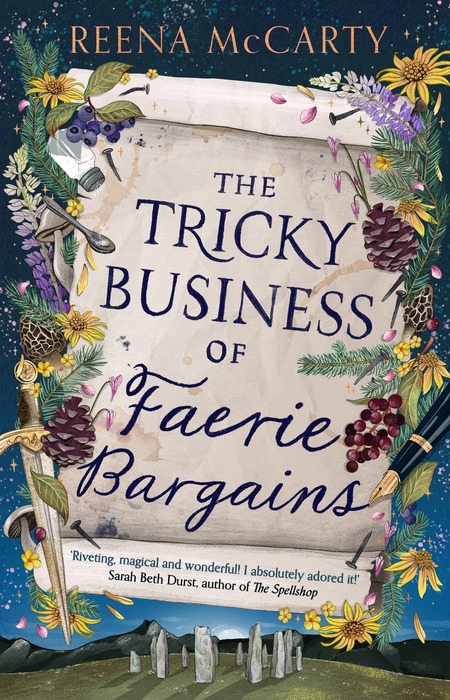
(courtesy Hachette Australia)
If the wondrously good Emily Wilde trilogy of books by Heather Fawcett didn’t convince you that fairies aka faeries were a whole lot of malevolently inconsistent bad news, and nothing like their Disneyfied modern image of light and flittery loveliness, then get ready for the similarly superlative The Tricky Business of Faerie Bargains by Reena McCarty will surely do the job.
While most people will think of Tinker Bell or romanticised Shakespearian notions when they think of faeries, the truth is that these mythical beings (or are they?) of long belief and standing are actually “complicated and unfailingly cruel creatures” who “[populate] “that darkness, that unknown space through which the meagre lights from candles and lanterns couldn’t penetrate.”
They are, in other words, perfect for some brutally dark and honest fantasy storytelling, and while McCarty does invest some levity and whimsicality into her gloriously magical novel, much of the narrative acknowledges that faeries are not the sort of beings you would want to invite home for dinner.
Or, as the title suggests, enter into a bargain with, because while most people will call a spade a spade and accept that a particular phrase or sentence means the obvious, and will honour the letter of the law, faeries will not, always eager to find loopholes that they can use to their self advantage.
In fact, so capricious and self-serving are these beings that in an alternate version of our world, where humans regularly cross over to the “Otherside” or the land of the fae, there exists a whole bureaucratic apparatus to ensure people do not fall victim to faerie malevolence.
My last thought before drifting off was that if someone told me that morning I’d be spending the night Otherside, I would have said they’d lost it. Completely and totally. But here I was. Home again.
Faerie magic has a great deal to offer people, and there is no shortage of clients eager to strike a magical “deal with the Devil” to advance their careers or overall lives in some way.
But what looks straightforward to us is devious and tricksy to the fae who live in a world where contracts, while as natural as breathing and something they love and adore and enter into it without compulsion, are there to be manipulated at every opportunity.
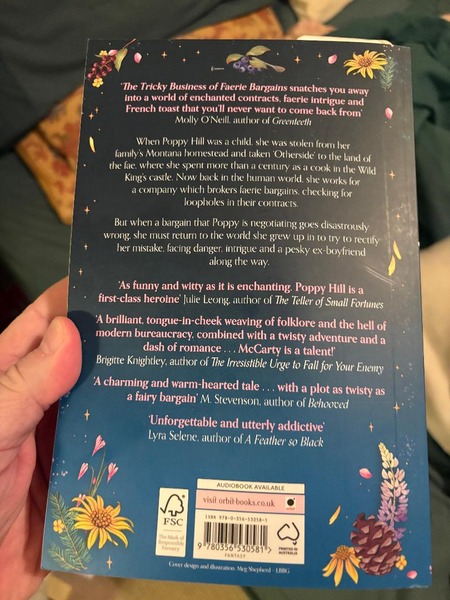
Someone who knows this better than anyone is Poppy Hill, the hugely likeable protagonist of The Tricky Business of Faerie Bargains, who was kidnapped off her family’s property in Montana in the 1880s and who only emerged back into what’s termed “Reality” after spending over a century cooking in the King’s castle.
She now works for Carter Lane, an entity set up by the US Government under a 1938 piece of legislation who regulate, by agreement of the fae and humans alike, who can enter into a contract and what kind of contract it can be.
They stand as the guardians of human interactions with the fae, who back this highly regulated system of contractual agreement after multiple millennia of simply taking what they want from people however they wanted led to them being essentially wiped out in Europe.
Eager to escape the same fate in the United States to which many Europeans fae refugees fled, and all too aware that they are already hemmed in by iron spikes all across the country, which curb the spread of fae populations – the allegories to the way in which westward expansion of European settlement dispossessed the First Nations people of the U.S. are commented upon more than once – the fae yield to this contractual system lest they lose their last spread of homelands.
But Carter Lane also exists to rehabilitate people like Poppy who arrive back in “Reality” with no real human aptitude and unable to function in a world of technology, much of which the fae rely on to sustain their own society.
We met the very lovely Poppy three years or so into her rehabilitative journey where she works alongside human legal people like her friend Gloria to make sure that contracts between the fae and humans are so watertight and devoid of easily twisted phrases that they former cannot mercilessly exploit the latter.
But then Poppy is caught up unwittingly in a deal gone wrong with her only way to fix things involving her returning to the “Otherside” where she has to battle capricious ex-boyfriends and supposed besties, political and military rivalries involving the various “courts” that govern fae life and a conspiracy which could see everything humans and fae have built up come tumbling down around them.
It’s here that The Tricky Business of Faerie Bargains thrives, spinning a story that twists and turns, which is full of light and adventure and a great deal of fun but also some fairly fierce darkness too.
Othersiders aren’t kind. It was absurd to think of them being nice. They demanded. They bargained. They offered favors [sic] in return for debt. I loved Elan, I trusted Sloan like family, but I would never expect either of them to go out of their way for me if they couldn’t get something in return.
What McCarty has created in the pages of The Tricky Business of Faerie Bargains is magical in every sense of the word.
The world-building is sprawling, vibrantly imaginative and compellingly thoughtful, the characters like Poppy but a great many others sparkle and leap off the page with fully-formed verve and the dialogue crackles with wit and cleverness and a buoyant sense of words being used as much as weapons as things of descriptive and emotional beauty.
Full to the brim with warmth and rich emotion, and mischievous sense of wicked delight, thanks in large part to Poppy’s ex Elan who means well but who can resist being a fae with all the manipulative inconsistency and self-servingness that involves, The Tricky Business of Faerie Bargains gives us a mythical world which you really don’t want to be a part of if you can help it with Carter Lane actively trying to persuade people not to journey to the “Otherside”.
Combining folklore and a delicious parody of the vagaries and blandness of the modern world, which protects things, yes but at what cost, The Tricky Business of Faerie Bargains is a supremely enjoyable joy to read, full of darkness and twisty-turny nasty intrigue, but also lightness and brightness and fun, a novel which you will want to return to but with a keen sense that the faeries that you knew from childhood are not the beings you thought they were.
And in the context of this wonderful piece of storytelling, that’s a very good thing indeed.