
(courtesy IMDb)
When we are young and brimming with self confidence and optimistic expectation, it’s near impossible to think of a time when all the certainties of our youth might fall away in a kind of existential cataclysm that will make us wonder if there’s a future worth having at all.
It’s doesn’t happen to everyone, and thank the gods for that, but there are a great many people who come to the end of themselves and who can’t see any way forward that doesn’t involve leaving this life altogether.
Even getting close to that point is terrifying and numbing all at once – as someone who grapples with anxiety and depression, it still amazes me that you can sitting at rock bottom, which everything should feel neon-level awful and you feel … NOTHING – but Pauli (Samuel Kujala), the lead character in A Light That Never Goes Out (Jossain on valo joka ei sammu), has reached that point, his life only saved by his own hand when he calls his parents to come and get him.
That suicidal ideation and action has seized Pauli is obliquely referred to at in the beginning of the film, with hinted at moments filled in with subtlety, nuance and care as the story progresses, when his parents Eija and Matti (Mari Rantasila and Jarkko Pajunen) come to collect from his modernist presumably Helsinki apartment to take him back to his hometown of Rauma.
Pauli, feted for his talent as a leading-edge, globally renowned flautist, is a shell of his former high-flying self, dressing only in his customary orchestral black and barely managing to do more than gaze dully at his family and the world around him.
He finally admits much later on that he has been driving himself for twenty years with an obsessive intensity to be the absolute best he can be only to find that all that effort and all those achievements left him feeling dully empty and achingly lost inside.
He attempts to reconnect with his life before his suicide attempt but finds only fury and despair, with his flute baring the brunt of much of his agony; it’s the regretted maiming of his instrument that sees him reconnect with his childhood friend and onetime fellow music student Iiris (Anna Roaliina Kauno) at a music shop in town.
This fortuitous meeting sees Pauli slowly come alive again as he begins to join Iiris and her friend Sini (Camille Auer) in the creation of some decidedly unclassical experimental music.
While this is a turning point in a sense in A Light That Never Goes Out (Jossain on valo joka ei sammu), the writer and director of the film, Lauri-Matti Parppei who says the story is loosely autobiographical, is far too clever and insightful to pretend it’s like some sort of magic wand that immediately transforms Pauli’s life.
In a Hollywood movie, yes, that would most certainly be the case, with all kinds of swelling triumphant music accompanying montages and scenes of someone overcoming internal darkness and adversity, but A Light That Never Goes Out (Jossain on valo joka ei sammu) doesn’t pretend for a second that life is so easy to fix.
Pauli’s road out of the darkness is far more prolonged and one-step-forward- two-steps-back than that and it’s good thing too because the film, which is happy to sit in discomfort and disquiet and admit to the fact that liberating self-epiphanies take a while to realise, benefits from letting Pauli appear to go forward before he goes back.
It might go counter to this inner need we all have for the dark things of life to be quickly replaced by the light, and while you can understand that impelling need we all have to feel okay with life again since who wants to feel like something supposedly so wonderful can be our enemy, but it feels real, so real, and that makes the film’s final act feel like something suitably earned.
You won’t be surprised maybe by where A Light That Never Goes Out (Jossain on valo joka ei sammu) ends up but the great pleasure of the film is how it reaches that point, always remembering that human nature is contrary, that we don’t always see and know what’s best for us, especially when we have sunk into a despairing hole and that finding our way to somewhere new is always a big ask.
It takes us a long time to let go of well entrenched ideas and comfort zones, even when they have inadvertently med to our degradation and harm, and the film acknowledges that in ways that feel quite freeing and reassuring.
Whether you like the experimental music Iiris and Sini, and then Pauli, produce is another thing entirely, and there are times where even your most adventurous ability to embrace new things may be tested, but the issue here is not so much if the music is to your liking, because even Pauli comes to doubt that for a time but whether what it represents a way forward, a new life that he can live with and even thrive in.
At its heart, A Light That Never Goes Out (Jossain on valo joka ei sammu) is a sensitively written and quietly but powerfully acted film which doesn’t rush to prove a point or reach grand punctuation points in its narrative but which is happy to sit in the darkness and the sadness and the lostness until, slowly but surely but not always in a neatly linear fashion, some sort of new path emerges.
It’s evocation of real life in all its mess and hope-defying illogicality is oddly reassuring because it doesn’t ask Pauli, or you as the viewer to have all the answers and in fact embraces the fact that answers, such as they are, can duck and weave and make themselves almost impossible to find at times.
A Light That Never Goes Out (Jossain on valo joka ei sammu) might reach a good and musically beautiful place at the end of its unhurried and sometimes uncertain story but it gets there by embracing the darkness, understanding the way even the most certain of people can get lost and showing away forward that feels achievable and when you’ve been in the very heart of the worst of places, that can feel like the most wonderful and hopeful thing of all.
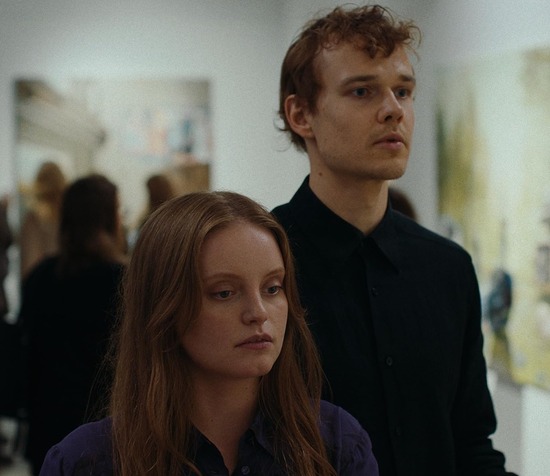
(courtesy IMDb)